
Last updated: September 15, 2026. Prices and customs checked against 2026 street food rates in Hanoi, Ho Chi Minh City, Hoi An, Da Nang, and Hue.
To order food in Vietnam in 2026, pick a busy stall, point at the dish, say the quantity, and follow the eat first, pay later rule. Pay in cash using small denominations, and tipping is not expected. Mastering a few phrases like tính tiền makes ordering street food seamless, whether you want a bowl of phở bò or a crispy bánh mì.
Our editorial team has spent a combined 18 months living and eating across Vietnam, from Saigon street stalls to Hoi An markets. All prices below were verified on the ground in January 2026.
At a Glance: How to Order Food in Vietnam in 7 Steps
Ordering food in Vietnam follows seven repeatable steps: choose a busy stall, signal the vendor, confirm quantity, eat first, pay cash.
How to order food in Vietnam starts with timing and location. The safest quality indicator is a stall packed with local customers. Meal times: breakfast 6:00 AM to 9:00 AM, lunch 11:30 AM to 1:00 PM, dinner 6:00 PM to 8:00 PM.
The process to order food in Vietnam relies on this exact sequence:
Find a busy stall with locals
A crowd of Vietnamese customers is the best indicator of fresh, safe food.
Make eye contact or say “Chị ơi”
Get the vendor’s attention with a raised hand or a friendly call.
Point at the dish and indicate the quantity
Hold up fingers for quantity: một, hai, ba, bốn, năm (1-5).
Specify your spice level or dietary needs
Say không cay (not spicy) or ăn chay (vegetarian) right after the dish name.
Eat first
Street stalls operate on an eat first, pay later system.
Say “Tính tiền” to request the bill
This means “the bill, please” – say it when you finish eating.
Pay in cash using small Vietnamese dong denominations
Carry 10,000, 20,000, 50,000, and 100,000 VND notes; avoid 500,000 VND bills.
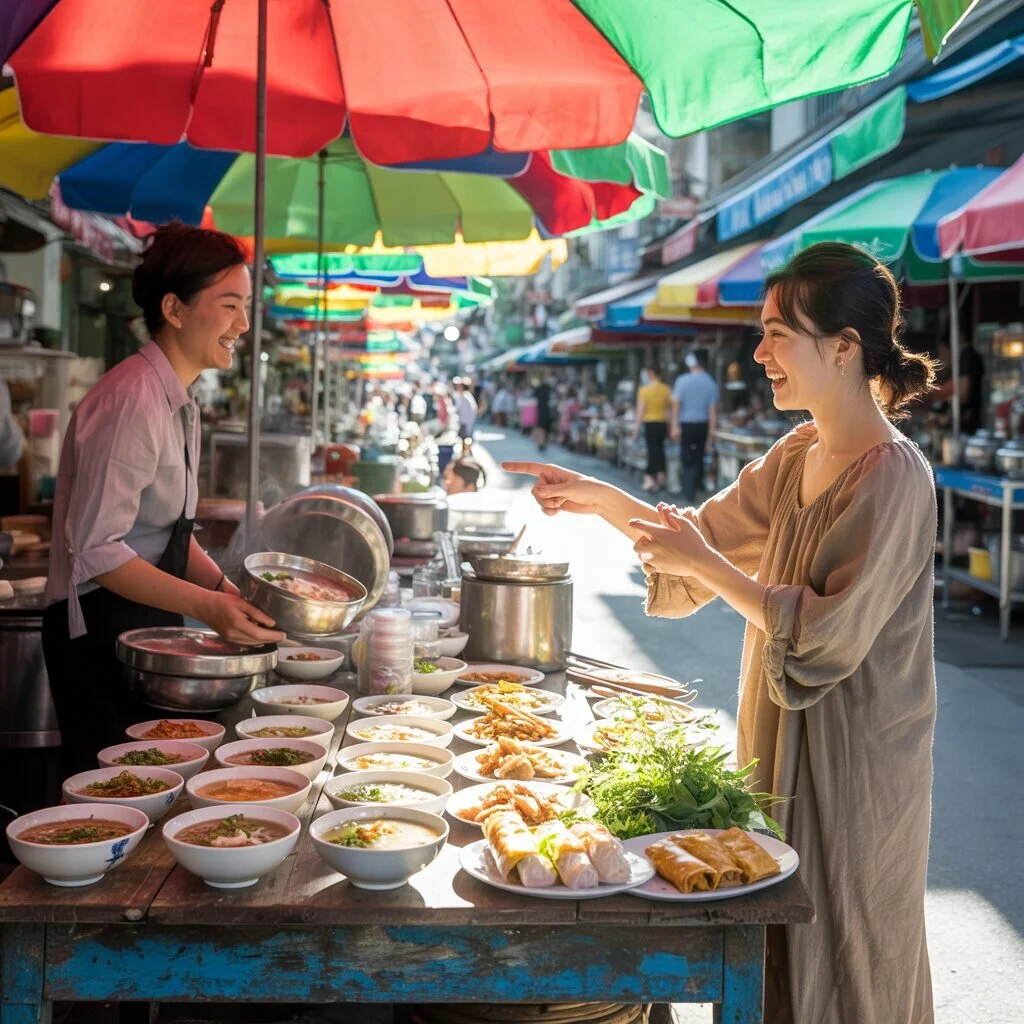
During my first week in Hanoi, I pointed at a steaming pot of phở and simply said “Một tô.” The vendor smiled and handed me a bowl. Confidence and a smile work better than perfect pronunciation when you order food in Vietnam.
Choosing the Right Street Stall to Order Food in Vietnam (and Getting a Vendor’s Attention)
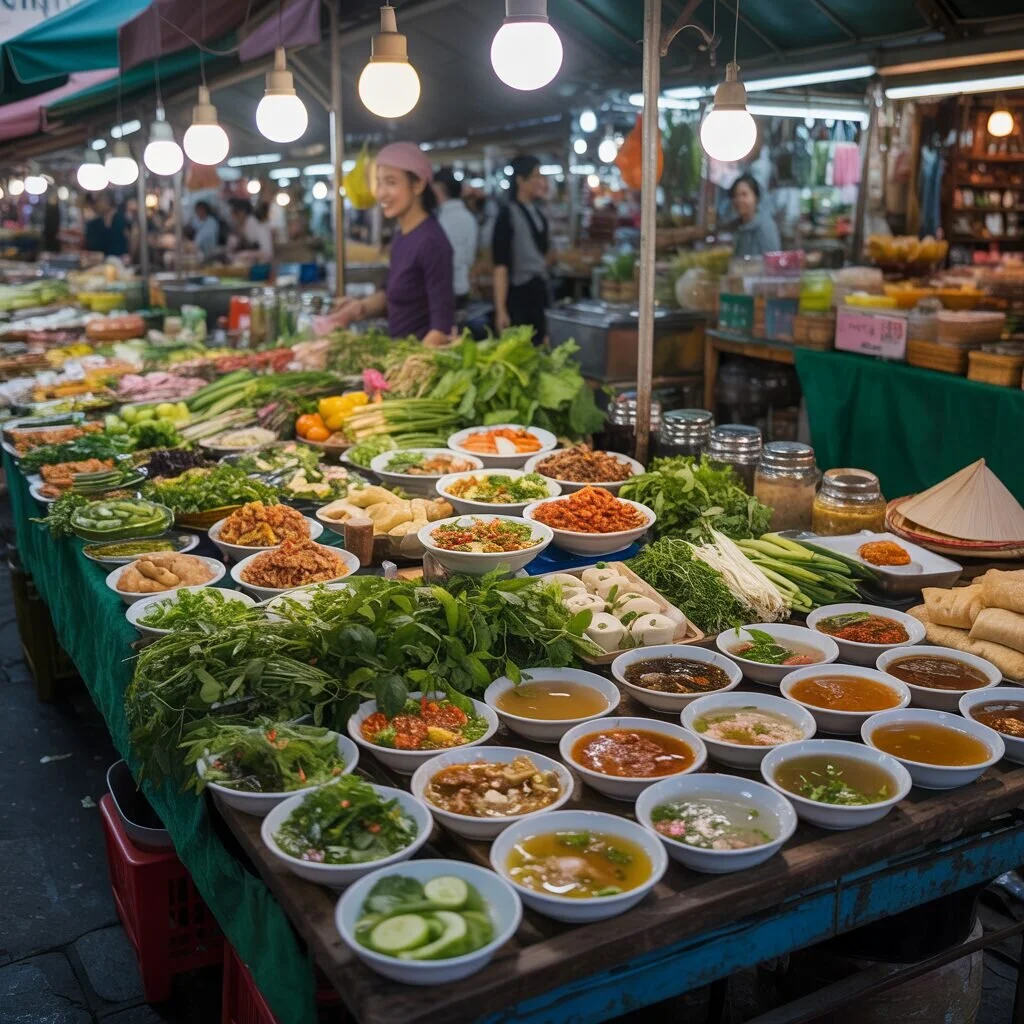
A busy stall with local customers and visible food preparation is the single best indicator of fresh, safe street food in Vietnam.
To order food in Vietnam safely, apply this hygiene checklist:
- High local turnover: a crowd of Vietnamese customers means fresh ingredients.
- Visible cooking: food prepared in front of you, not sitting pre-cooked for hours.
- Busy hours: stalls packed at meal times rotate stock fastest.
| Meal | Hours |
|---|---|
| Breakfast | 6:00 AM – 9:00 AM |
| Lunch | 11:30 AM – 1:00 PM |
| Dinner | 6:00 PM – 8:00 PM (stools set up by 5:00 PM) |
How to Get a Vendor’s Attention
Eye contact plus a raised hand is enough to order food in Vietnam. Vocally, call Em ơi for a younger person, Chị ơi for a woman slightly older, Anh ơi for a man slightly older, or Cô ơi / Chú ơi for an older woman or man. The word ơi is a friendly call, never rude.
Ordering When You Speak Zero Vietnamese: Dish Names, Gestures and Pointing
Order food with zero Vietnamese: use the Google Translate camera, GrabFood as a visual menu, pointing, and counting on fingers.
The zero-language workflow to order food in Vietnam:
Open GrabFood
Find the dish photo you want
Show the screenshot
Present it to the vendor
Point and hold up fingers
Indicate the dish and quantity
Confirm the price
Ask “Cái này bao nhiêu?”
| Dish | What It Is | Typical Price (2026) |
|---|---|---|
| Phở bò | Beef noodle soup | 40,000-70,000 VND |
| Bún chả | Grilled pork with noodles | 40,000-60,000 VND |
| Bánh mì | Vietnamese sandwich | 30,000-50,000 VND |
| Cơm tấm | Broken rice with grilled pork | 35,000-60,000 VND |
| Trà đá | Iced green tea | 2,000-5,000 VND (often free) |
Hand Gestures and Pointing Rules
Pointing at food is completely acceptable when you order food in Vietnam. Hold up fingers for quantity: một, hai, ba, bốn, năm (1-5). Never point at people; point at the dish or the pot.
Essential Vietnamese Phrases for Ordering Food in Vietnam
Nine core phrases cover the entire street food ordering workflow in Vietnam.
Word order to order food in Vietnam: quantity + classifier + dish name. Classifiers: tô (bowl, for phở/bún), dĩa (plate), ly/chai (glass/bottle), ô/cái (for bánh mì), phần (portion).
| Vietnamese Phrase | English Meaning |
|---|---|
| Cho tôi | Give me |
| Tôi muốn gọi món | I want to order |
| Một tô phở | One bowl of pho |
| Cái này bao nhiêu? | How much is this? |
| Không cay / Ít cay | Not spicy / Less spicy |
| Không thịt / Ăn chay | No meat / Vegetarian food |
| Tôi bị dị ứng… | I am allergic to… |
| Tính tiền | The bill, please |
| Làm ơn / Cảm ơn | Please / Thank you |
Addressing the Vendor
Call Em ơi (younger person) or Chị ơi (woman slightly older) to order food in Vietnam. If you speak zero Vietnamese, open GrabFood as a visual menu and point at the picture.
Spice, Vegetarian, and Allergies
Say không cay (not spicy) or ăn chay (vegetarian) right after the dish name. For allergies, use “Tôi bị dị ứng…” followed by the food.
How to Use Chopsticks Like a Local When You Order Food in Vietnam
Grip: top stick between thumb and index finger, bottom rests on the middle finger. Never stick chopsticks upright in rice.
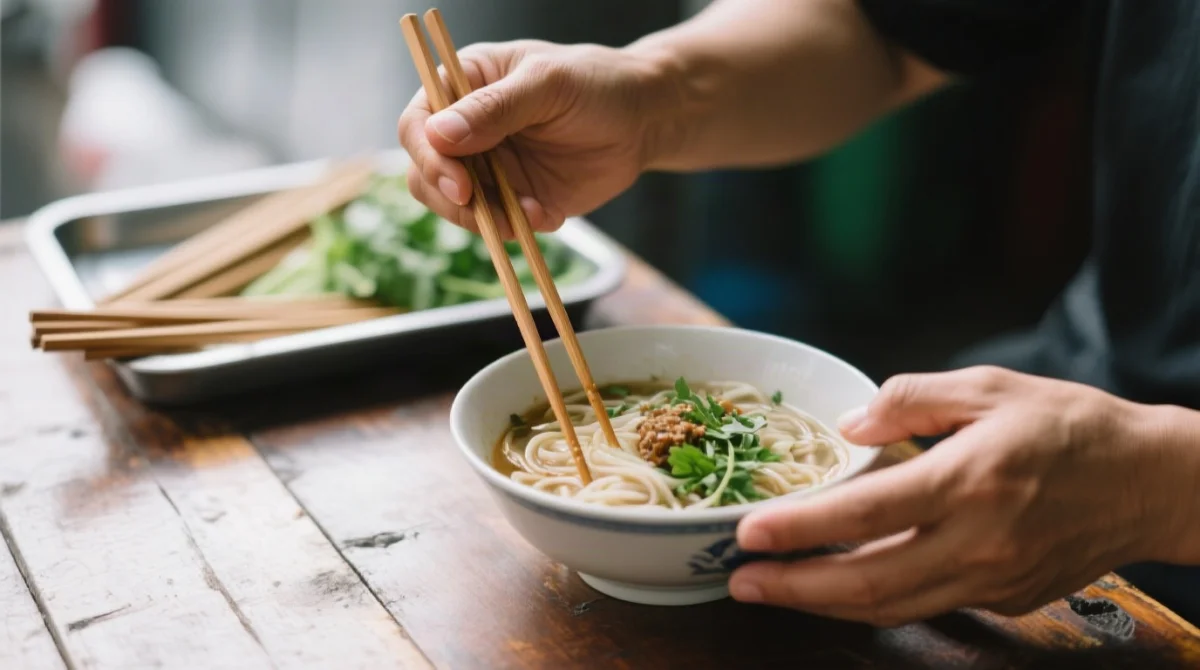
When you order food in Vietnam, vendors provide utensils at your table. Technique:
- Top chopstick: held between thumb and index finger, it moves.
- Bottom chopstick: rests on the middle finger, it stays still.
- Scoop food; never stab it.
Chopstick Taboos
Never stick chopsticks upright in rice: this resembles incense burned at a funeral. Never pass food chopstick-to-chopstick. These taboos are also documented by the Vietnamese Ministry of Culture, Sports and Tourism (bvhttdl.gov.vn).
Asking for a Fork
Asking for a fork or spoon is perfectly acceptable when you order food in Vietnam. Say “Cho thêm đũa” for a fresh pair if yours fall on the floor.
Paying for Your Meal: Cash, Apps and Delivery
Street stalls in Vietnam operate on an eat first, pay later system and accept almost exclusively Vietnamese dong cash in small denominations.
Worked example: your bill is 75,000 VND. Hand over a 100,000 VND note and receive 25,000 VND change. Settle the bill by saying “tính tiền”.
| Payment Method | Accepted at Street Stalls? |
|---|---|
| Cash (VND) | Yes, universally |
| E-wallets (MoMo, ZaloPay) | Rarely; popular with locals, not tourists |
| International cards | No |
ATM and Cash-Break Tips
Carry 10,000, 20,000, 50,000, and 100,000 VND notes. Never hand a 500,000 VND note at a stall: vendors rarely have change.
GrabFood, ShopeeFood, and Be
Delivery apps GrabFood, ShopeeFood, and Be accept cash on delivery universally, and international cards increasingly work in-app. Sidewalk stalls where you order food in Vietnam remain strictly cash-only.
Street Food Prices in Vietnam (2026)
In 2026, a bowl of phở costs 40,000-70,000 VND and a bánh mì costs 30,000-50,000 VND at Vietnamese street stalls.
| Dish | VND (2026) | ~USD | Notes |
|---|---|---|---|
| Phở bò | 40,000-70,000 | $1.60-2.80 | Beef noodle soup |
| Bánh mì | 30,000-50,000 | $1.20-2.00 | Vietnamese sandwich |
| Cà phê sữa đá | 25,000-40,000 | $1.00-1.60 | Iced coffee with condensed milk |
| Trà đá | 2,000-5,000 | $0.08-0.20 | Often free |
Price ranges reflect typical central Hanoi and Ho Chi Minh City stall prices as of 2026, cross-checked with Viet Nam National Authority of Tourism data (vietnamtourism.gov.vn, accessed September 2026). Tourist-heavy areas may charge 10-20% more; confirm before you order food in Vietnam.
How to Spot Overcharging
- No displayed prices: ask “Cái này bao nhiêu?” before eating.
- Tourist-only clientele: locals know where value is.
- Menus in USD only: a red flag at so-called cơm bình dân (budget rice) spots.
Tipping in Vietnam: What You Need to Know
Tipping is not expected at Vietnamese street stalls; rounding up by 5,000-10,000 VND is appreciated but never required.
| Venue | Expected? | Amount |
|---|---|---|
| Street stalls | No | Round up 5,000-10,000 VND (optional) |
| Mid-range restaurants | No | 5-10% or round up; check for added service charge and VAT first |
| Tour guides | Appreciated | 50,000-100,000 VND per day |
Never tip in US dollars when you order food in Vietnam: vendors cannot easily exchange small USD amounts. Vietnamese dong only.
Bargaining at Street Stalls and Markets: When to Haggle and When Not To
Haggle at markets and souvenir stalls, never at street food stalls (fixed prices).
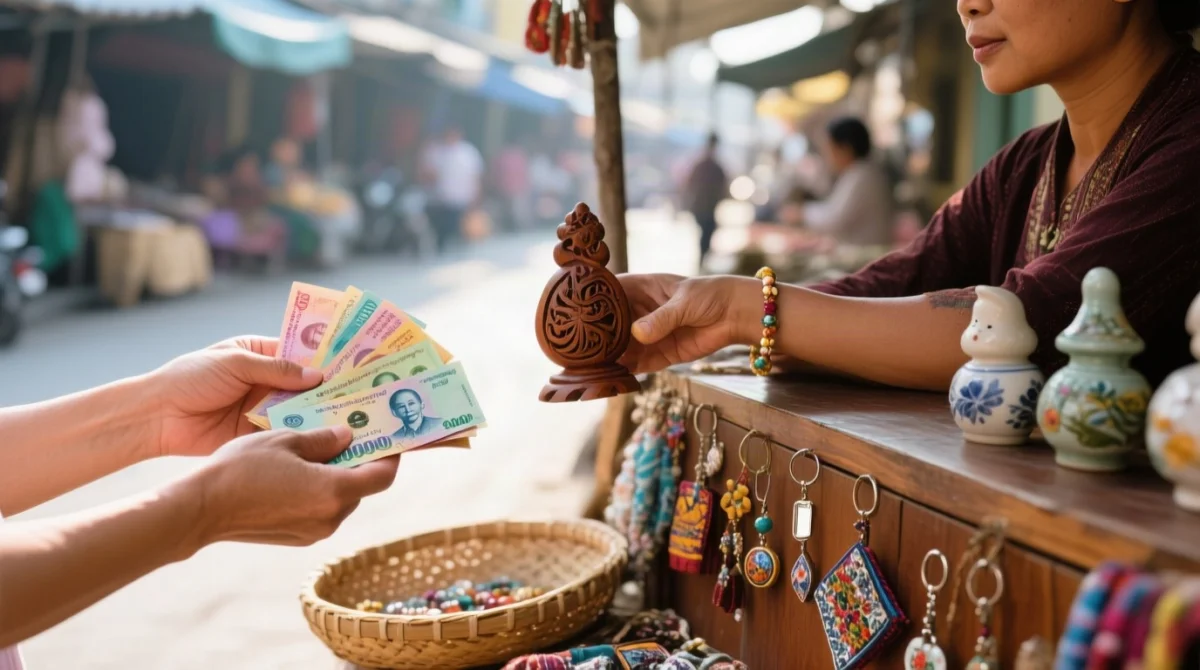
Never haggle over food priced under 100,000 VND when you order food in Vietnam. Vendors set exact prices for daily customers; negotiating a 40,000 VND bowl of phở is impolite.
| Do Haggle | Don’t Haggle |
|---|---|
| Souvenirs at night markets | Street food meals |
| Clothing, non-food goods | Drinks and bottled water |
When haggling for non-food items, open at 50-60% of the asking price and close at 65-75%.
Essential Bargaining Phrase
Ask “Bớt đi bao nhiêu?” (How much discount?) politely at flexible-price markets.
Vietnamese Dining Etiquette Every Foreign Visitor Should Know
Lifting the soup bowl to your mouth and slurping are normal and polite in Vietnamese dining culture.
- Sharing a table with strangers is normal during peak hours. Smile and take a seat.
- Lifting the bowl and slurping shows appreciation.
- Tables feature free condiments like nước mắm (fish sauce).
Condiments and What Comes Free
Trà đá is often free. Pro tip from experience: keep a 10,000 VND note ready for trà đá. Many vendors will not charge you, but offering to pay shows respect and often earns a free refill.
What to Say After the Meal
Say “Ngon quá!” (delicious!) when you finish. Vendors remember polite foreigners, and it is the nicest way to end the experience of ordering food in Vietnam.
Common Mistakes and Food Safety When Ordering Food in Vietnam
Paying with a 500,000 VND bill, bargaining over food, and assuming card acceptance are the most common foreign visitor mistakes.
- Handing over 500,000 VND notes: stalls lack change.
- Haggling over a 40,000 VND bowl: fixed prices, considered rude.
- Assuming cards work: stalls are cash-only.
- Tipping in USD: use dong.
- Sticking chopsticks upright in rice: funeral symbol.
- Skipping busy local stalls for empty tourist ones: worse food, higher risk.
- Drinking tap water: bottled only.
- Ordering outside meal hours: many stalls close after 8:00 PM.
Food Safety and Hygiene
Drink bottled water only; ask for “đá sạch” (clean ice from sealed bags) in cold drinks. Buy travel insurance before your trip: US plans rarely cover treatment in Vietnam. For external travel advisories, contact the Viet Nam National Authority of Tourism:
Email: contact@vietnamtourism.gov.vnFrequently Asked Questions (FAQ)
Is tipping expected at street stalls in Vietnam?
Tipping is not expected at street stalls; rounding up 5,000-10,000 VND is appreciated. Never tip in USD.
Can you bargain for street food in Vietnam?
No. Never haggle over any food item priced under 100,000 VND; bargaining is for markets and souvenirs only.
What does ‘Tính tiền’ mean?
It means “the bill, please.” Street stalls use an eat first, pay later system, so say it when you finish eating.
Is the ice safe to drink in Vietnam?
Tap water is not safe; drink bottled water. Ice marked đá sạch (clean ice from sealed bags) at reputable stalls is generally safe.
How do I ask for vegetarian food in Vietnam?
Say ăn chay (vegetarian food) or không thịt (no meat) right after the dish name.
What is the rule for sharing tables in Vietnam?
Sharing a table with strangers during peak meal hours is completely normal. Smile and keep eating.
How much does a bowl of pho cost in 2026?
Between 40,000 and 70,000 VND at street stalls in 2026, depending on region.
Can I pay with a credit card at street stalls?
No. Stalls accept cash in Vietnamese dong only. Carry 10,000-100,000 VND notes and avoid 500,000 VND bills.
What is the best time to eat street food in Vietnam?
Breakfast 6:00-9:00 AM, lunch 11:30 AM-1:00 PM, dinner 6:00-8:00 PM.
Is it rude to ask for a fork instead of chopsticks in Vietnam?
Not at all. Vendors happily provide a fork or spoon on request.