

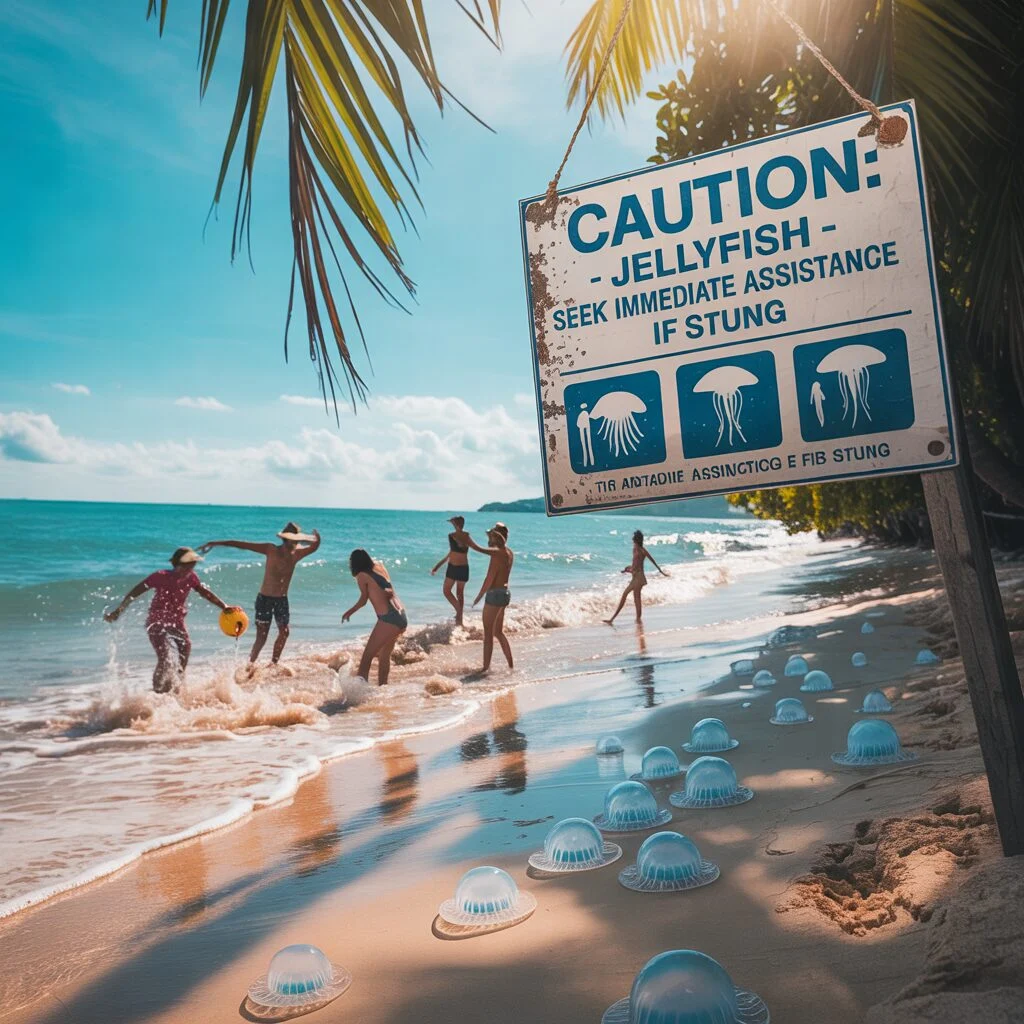
Jellyfish stings and common problems on Vietnam beaches include rip currents, tourist scams, trash, overcrowding, and sunburn. Correct first aid involves a seawater rinse, tentacle removal, and hot-water immersion (40-45°C) to prevent complications. Save Vietnam’s emergency number 115 for ambulance access at tourist beaches. Preparation is your best defense against local hazards like the Physalia physalis (fire jellyfish) confirmed in Nha Trang and Phu Quoc, so learning how to plan a Vietnam beach itinerary is essential.
Dangerous Jellyfish Species and Stings on Vietnam Beaches
Physalia physalis (Portuguese man o’ war, also called “bluebottle”) stings are confirmed in Nha Trang (Khanh Hoa Province) and Phu Quoc (Bai Sao, Kien Giang Province), causing burning pain, welts, blistering, and potentially life-threatening cardiac complications. This species belongs to the family Physaliidae. Vietnam is also listed among countries covered by the IOC-WESTPAC General Management Guide for Harmful Jellyfish Stings (2022), which treats Cubozoa (box jellyfish) as a separate class.
Approximately 150 million sting incidents occur globally per year, with the Indo-Pacific region of particular concern. The pathophysiology involves nematocysts – specialized organelles that discharge venom into human skin upon contact, one of nature’s most rapid mechanical events. Skin symptoms vary by class: Cubozoa stings produce whip-like, cross-hatched lesions with a “frosted” appearance from superficial necrosis; Hydrozoa stings create linear “string of beads” rashes; Scyphozoa stings form jellyfish-shaped erythematous lesions. Per a 2024 review in Med Sci Monit (PMC11297359), local symptoms persist 1-2 weeks to several months, with possible pigmentation changes or scarring despite treatment.
| Month | Destination | Risk Level |
|---|---|---|
| May-August | Nha Trang (Khanh Hoa) | High |
| December-February | Phu Quoc (Bai Sao) | Moderate |
| Year-round | Da Nang / My Khe | Variable |
| Species | Class | Lesion Type | Treatment Note |
|---|---|---|---|
| Physalia physalis (bluebottle) | Hydrozoa | Linear “string of beads” | Avoid vinegar; use seawater |
| Box jellyfish | Cubozoa | Whip-like, cross-hatched, “frosted” | Vinegar effective |
| True jellyfish | Scyphozoa | Jellyfish-shaped erythematous | Seawater rinse |
Dr. Nguyen Thi Thanh Thuy, Head of dermatology for women and children at the National Hospital of Dermatology and Venereology (Hanoi), treats numerous sting cases each year. She advises: if jellyfish are visible, especially brightly colored ones, do not enter the water.
How to Identify Dangerous Jellyfish Before You Swim
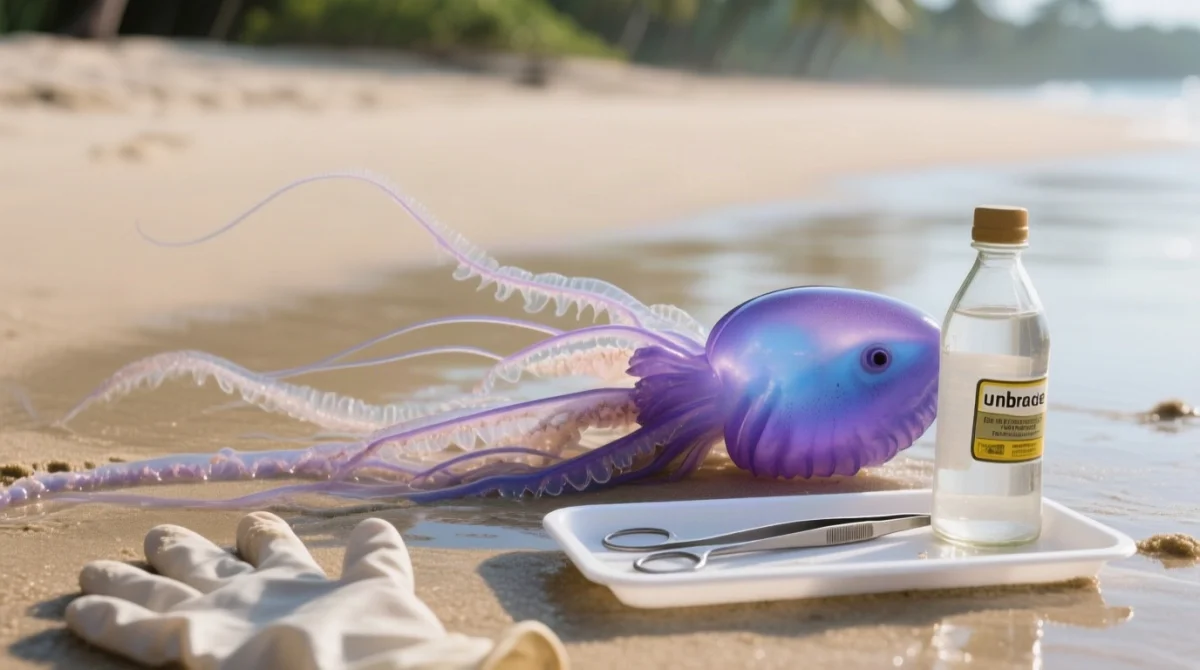
Look for bright colors or transparent bodies. Portuguese man o’ war appears as a purple/blue balloon with long tentacles. Washed-up jellyfish remain venomous – do not touch. Check beach warning signs and ask local residents whether jellyfish are present before swimming.
Where Jellyfish Appear Along Vietnam’s Coast (2026 Risk Notes)
Jellyfish stings on Vietnam beaches vary by region, even among the top beaches to visit in Vietnam. Nha Trang carries highest risk May-August; Phu Quoc’s Bai Sao has winter sightings (a May 2020 incident required a hospital visit); Da Nang/My Khe remains variable year-round; Mui Ne moderate; Hoi An (An Bang) low-moderate. Warm currents and monsoon winds drive fire jellyfish and Cubozoa into shallow waters.
First Aid for Jellyfish Stings – Step-by-Step
Rinse jellyfish stings with seawater, remove tentacles with a card, and immerse in hot water (40-45°C) for 20-45 minutes; never use fresh water. Per a May 2025 Tuoi Tre alert, improper treatment can cause secondary infections or sepsis.
- Leave the water immediately. Do not touch tentacles with bare hands.
- Rinse with seawater – never fresh water, which triggers nematocyst discharge and worsens venom effects.
- Remove tentacle fragments using the edge of a bank card, tweezers, or gloves.
- Immerse in hot water (40-45°C) for at least 30 minutes. The NHS recommends water “as hot as can be tolerated.”
- Assess symptoms – check for fatigue, rapid heartbeat, or excessive sweating. Consult a doctor even if symptoms seem minor.
| Do | Don’t |
|---|---|
| Rinse with seawater | Use fresh water |
| Remove tentacles with a card | Touch tentacles with bare hands |
| Immerse in hot water (40-45°C) | Apply ice or alcohol directly |
| Take paracetamol for pain | Rub or scratch the wound |
Take paracetamol or ibuprofen for pain. Antihistamine cream is available from local pharmacies for allergic reactions. First aid for jellyfish stings must be evidence-based to prevent complications.
Does Vinegar Work on Jellyfish Stings in Vietnam?
Vinegar is effective for box jellyfish (Cubozoa) stings, but with Physalia physalis it may increase toxin release. Use seawater as the safe common denominator when the species is unknown, then apply a hot compress.
What NOT to Do After a Jellyfish Sting
Do not rub or scratch the wound, apply fresh water, alcohol, or ice. Urine is a debunked myth that spreads venom and increases infection risk. The IOC-WESTPAC guide names “widespread belief in unscientific and inadequate methods” as a key regional problem.
How to Avoid Jellyfish Stings Before You Swim
To avoid jellyfish stings on Vietnam beaches, check local warnings, swim before 9 AM, read beach warning signs, and wear full-coverage lycra or neoprene swimwear. Beach warning flags indicate jellyfish presence – red or white flags are raised by lifeguards when stingers are detected. However, public beaches in Vietnam have limited lifeguard coverage, so self-reliance is essential.
Preventive measures include swimming in groups, avoiding wave-break edges and seaweed beds, and scuffing or stamping feet when walking in shallow water to alert nearby stingers. Wear waterproof shoes or sandals in rocky areas. Plan trips outside peak risk periods by checking the best time to visit Vietnam beaches to avoid summer in Nha Trang and winter sightings in Phu Quoc.
Dr. Nguyen Thi Thanh Thuy recommends full-coverage swimsuits for children to minimize contact with sensitive skin. Neoprene wetsuits and stinger suits prevent jellyfish stingers from penetrating – consider packing from the USA, as availability in Vietnam may be limited.
Protective Swimwear and Repellent Creams
Choose lycra, neoprene, or stinger suits for full coverage. Protective cream with plankton extract offers 4 protection levels (slip, confuse sensors, block communication, release inhibitors) in variants for children and adults. Water shoes protect feet in shallow or rocky areas.
Rip Currents on Vietnam Beaches – How to Identify and Escape
Rip currents on Vietnam beaches peak during monsoon season (September-November), especially on open-ocean stretches like Da Nang/My Khe, Mui Ne, and Phu Quoc’s Bai Sao. The US National Weather Service escape protocol: swim parallel to shore, never against the current, then angle back toward land once free.
| Flag | Meaning |
|---|---|
| Red | Dangerous conditions – do not swim |
| White | Jellyfish present – caution |
| No flag | No lifeguard on duty – self-reliance required |
Sheltered bays carry lower rip-current risk than open-ocean beaches. In 2026, check local beach notices, weather apps, and strong wind advisories before entering the water.
How to Spot a Rip Current in Seconds
Four visual signs: discolored or murky water, a foamy channel extending seaward, a gap in breaking waves, and water that does not get shallower as you stand. Monsoon winds amplify these conditions September through November.
What to Do If You’re Caught in a Rip Current
Stay calm, float on your back, conserve energy, and wave for help. Swim parallel to shore until free of the current, then angle back. Do not attempt to swim straight back to shore against the pull.
Common Beach Scams in Vietnam for Tourists – How to Avoid Them
Common beach scams in Vietnam target US tourists at rental kiosks and parking lots. Jet-ski operators often claim pre-existing damage to demand steep penalties. Always photograph equipment before departure, negotiate prices upfront in VND and USD, and never surrender your passport as collateral. A jet-ski rental should cost around 800,000 VND ($32 USD) per hour; verify prices before agreeing.
| Scam | How it works | Red flag | How to protect yourself |
|---|---|---|---|
| Jet-ski damage claim | Pre-existing damage charged to tourist on return | Refusal to inspect before departure | Photo/video equipment before rental; written agreement |
| Deposit trick | Passport taken as collateral instead of cash | Request for original passport | Never surrender passport; offer cash deposit |
| Fake tour operator | No company markings, cash-only, no receipt | No price list, no contact number | Verify online; book through known platforms |
| Overcharging | Sudden surcharges for fuel, “rescue equipment” | Price not quoted upfront | Ask price in VND and USD before agreeing |
Jet-Ski Damage Claims and Deposit Tricks
Document equipment with timestamped photos before leaving the kiosk. Decline any operator who refuses a pre-rental inspection. Never surrender your passport as collateral – offer a cash deposit instead. Keep a written agreement with the rental price stated upfront.
Red Flags for Fake Tour Operators and Overcharging
Six warning signs: no price list, rush pressure, cash-only without receipt, no insurance, “today only” urgency, and no company signage. Walk away from operators showing these red flags. Pay by card when possible and keep all receipts.
Trash, Water Quality, and Overcrowding on Vietnam’s Beaches
Wait 24-48 hours after heavy rain before swimming near urban beaches due to raw-sewage risk; open-ocean beaches carry lower sewage risk but stronger currents. Plastic bags, bottles, cigarette butts, and styrofoam dominate litter at urban beaches. Monsoon winds push debris onshore, and Tet holiday surges worsen waste accumulation.
| Beach | Waste Type | Water Quality | Advice |
|---|---|---|---|
| My Khe (Da Nang) | Plastic bags, bottles, cigarette butts | Declines after rain | Wait 24-48 h post-rain; arrive before 9 AM |
| Nha Trang main strip | Styrofoam, plastic bottles | Urban runoff risk | Choose north/south beaches instead |
| Bai Sao (Phu Quoc) | Seasonal debris | Generally cleaner | Reference point for water quality |
| Northern Phu Quoc / Con Dao | Minimal | Higher quality | Quieter, cleaner alternatives |
Peak crowd seasons run July-August, Tet holiday, and New Year, hitting My Khe, Nha Trang’s main strip, and Bai Sao hardest. Go before 9 AM or pick outer beaches to avoid the crush. Trash and overcrowding on Vietnam beaches peak during these periods.
Cleanest Beaches in Vietnam vs. High-Pollution Spots
Northern Phu Quoc, Con Dao, and Cat Ba outskirts offer cleaner sand and fewer vendors. Bai Sao (Phu Quoc) serves as a water-quality reference point, though a May 2020 sting incident occurred there. Urban beaches decline fastest after rain.
Quieter Alternatives to Vietnam’s Busiest Strips – Including Safest Beaches for Families
| Busy Beach | Quieter Alternative | Best For |
|---|---|---|
| My Khe (Da Nang) | Northern Phu Quoc / Con Dao | Cleaner sand, fewer crowds |
| Nha Trang main strip | North/south Nha Trang beaches | Less urban runoff |
| Bai Sao (Phu Quoc) | Northern Phu Quoc beaches | Higher water quality |
Family-safe criteria: sheltered bays, lifeguard presence, calm water, and pharmacy access. To find the right spots, check our guide to the best beaches in Vietnam for families. Hoi An’s An Bang beach offers a low-moderate jellyfish risk alternative to Da Nang.
Swimming After Heavy Rain – When to Wait
Apply the 24-48 hour rule at urban beaches (Da Nang, Nha Trang strip) due to raw-sewage risk. Open-ocean beaches face lower sewage contamination but higher rip-current exposure. If post-swim irritation, fever, or GI symptoms develop, seek medical care promptly.
Sunburn Prevention and Treatment on Vietnam Beaches
Vietnam’s UV Index typically reaches 8-11 in summer, peaking between 11:00 and 15:00, making sunburn a serious risk for fair-skinned US tourists. Use broad-spectrum SPF 50+ sunscreen, reapply every 2 hours, and choose reef-safe formulas free of oxybenzone and octinoxate.
| UV Level | Risk | SPF Needed | Reapplication |
|---|---|---|---|
| 8-9 | Very High | SPF 50+ broad-spectrum | Every 2 hours |
| 10-11 | Extreme | SPF 50+ broad-spectrum, water-resistant | Every 2 hours + after swimming |
Aftercare includes cooling compresses, aloe vera, moisturizer, and hydration. Watch for heat exhaustion signs: heavy sweating, weakness, dizziness, nausea, headache, and muscle cramps. If confusion or loss of consciousness occurs with no sweating, suspect heatstroke and call 115 immediately. Sunburn on Vietnam beaches is preventable with proper UV protection.
Best Reef-Safe Sunscreen for Vietnam (2026)
Select SPF 50+ broad-spectrum, water-resistant formulas that exclude oxybenzone and octinoxate to protect both your skin and Vietnam’s coral reefs. Local pharmacies carry reef-safe brands, though prices in VND may be higher than packing from the USA. Pair sunscreen with a hat, UV sunglasses, and shade breaks during peak UV hours.
Vietnam Emergency Numbers and Your Beach Safety Kit
Save Vietnam’s emergency numbers before you hit the sand: 115 (ambulance), 114 (police), and 113 (fire). Call 115 for any beach medical emergency.
Emergency Numbers in Vietnam – Save These Now
115 – Ambulance | 114 – Police | 113 – Fire
Private Vinmec hospitals in Nha Trang, Phu Quoc, and Da Nang offer English-speaking staff and treat sting cases, but require upfront payment. An ER consultation typically costs 1,500,000-3,000,000 VND ($60-$120 USD) – check current prices before your trip and include this in your Vietnam beach vacation cost. Public beaches have limited lifeguard coverage and few first-aid stations. Check your travel insurance policy for a “marine stinger” clause and medical evacuation coverage, as not all plans cover jellyfish envenomation.
What to Pack for a Vietnam Beach Vacation Safety Kit
- Vinegar (for non-Physalia stings)
- Tweezers or bank card for tentacle removal
- SPF 50+ reef-safe sunscreen
- Water shoes for rocky or shallow areas
- Sun hat and UV sunglasses
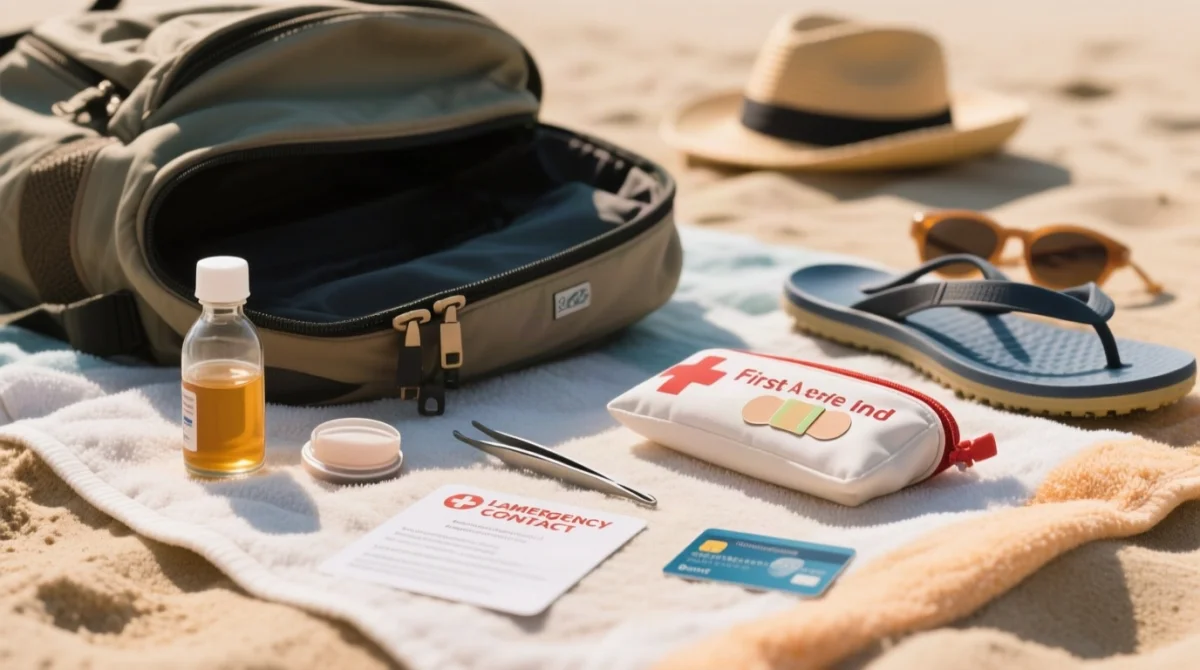
- First-aid basics: plasters, bandage, burn ointment, antihistamine cream
- Card with emergency numbers (115, 114, 113)
Pack these from the USA, as availability near remote beaches may be limited.
Costs, Insurance, and What to Expect at the Hospital
Private hospital visits include an ER consultation, basic tests, and pain medication. Keep all documentation for your insurer. Confirm whether your policy covers marine stinger incidents specifically. Vietnam emergency numbers and beach safety kit preparation reduce stress during an emergency.
FAQ: Vietnam Beach Safety
What should I do immediately after a jellyfish sting on a Vietnam beach?
Leave the water, rinse with seawater (not fresh water), remove tentacles with a bank card, and immerse in hot water (40-45°C) for 20-45 minutes. If severe symptoms occur, call 115 for an ambulance.
Are jellyfish stings in Vietnam dangerous, do I need a hospital?
Most stings cause pain and welts, but severe complications include breathing difficulties, cardiac issues, and sepsis from improper treatment. Consult a doctor even if symptoms seem minor; seek emergency care for chest pain or extensive blistering.
Does vinegar really work on jellyfish stings in Vietnam?
Vinegar is effective for box jellyfish (Cubozoa) but may increase toxin release with Physalia physalis stings. If the species is unknown, use seawater and a hot compress as the safe default.
When is jellyfish season in Vietnam?
Nha Trang has highest risk May-August; Phu Quoc has winter sightings; Da Nang is variable year-round. Check local conditions before swimming and do not enter if jellyfish are visible.
Are there box jellyfish in Vietnam?
Yes, Vietnam is covered by the IOC-WESTPAC guide, which treats Cubozoa (box jellyfish) as a separate class. Physalia physalis is also confirmed in Nha Trang and Phu Quoc.
What number do I call for a beach emergency in Vietnam?
Call 115 for an ambulance, 114 for police, and 113 for fire. Private Vinmec hospitals in Nha Trang, Phu Quoc, and Da Nang have English-speaking staff but require upfront payment.
Are rip currents common in Vietnam, and can you swim safely?
Rip currents are a known risk on open-ocean beaches like Da Nang, My Khe, Mui Ne, and Bai Sao, especially during monsoon season (September-November). Swim parallel to shore to escape, never against the current.
What are the most common beach scams in Vietnam?
Jet-ski damage claims, deposit tricks demanding your passport, overcharging, and fake tour operators. Photograph equipment before renting, never surrender your passport, and verify operators online.
Is the water safe to swim in after heavy rain in Vietnam?
Wait 24-48 hours after heavy rain at urban beaches due to raw-sewage risk. Open-ocean beaches have lower sewage risk but stronger currents; avoid swimming near visible trash or drainage outlets.
What should I pack for a Vietnam beach vacation safety kit?
Pack vinegar, tweezers or a bank card, plasters, burn ointment, antihistamine cream, SPF 50+ reef-safe sunscreen, UV sunglasses, a hat, water shoes, and a note with emergency number 115.
Jellyfish stings and common problems on Vietnam beaches include rip currents, tourist scams, litter, overcrowding, and sunburn. Prevention tips, correct first-aid steps for stings, and Vietnam emergency numbers – 115 for ambulance, 114 for police – keep travelers safe on the coast.