

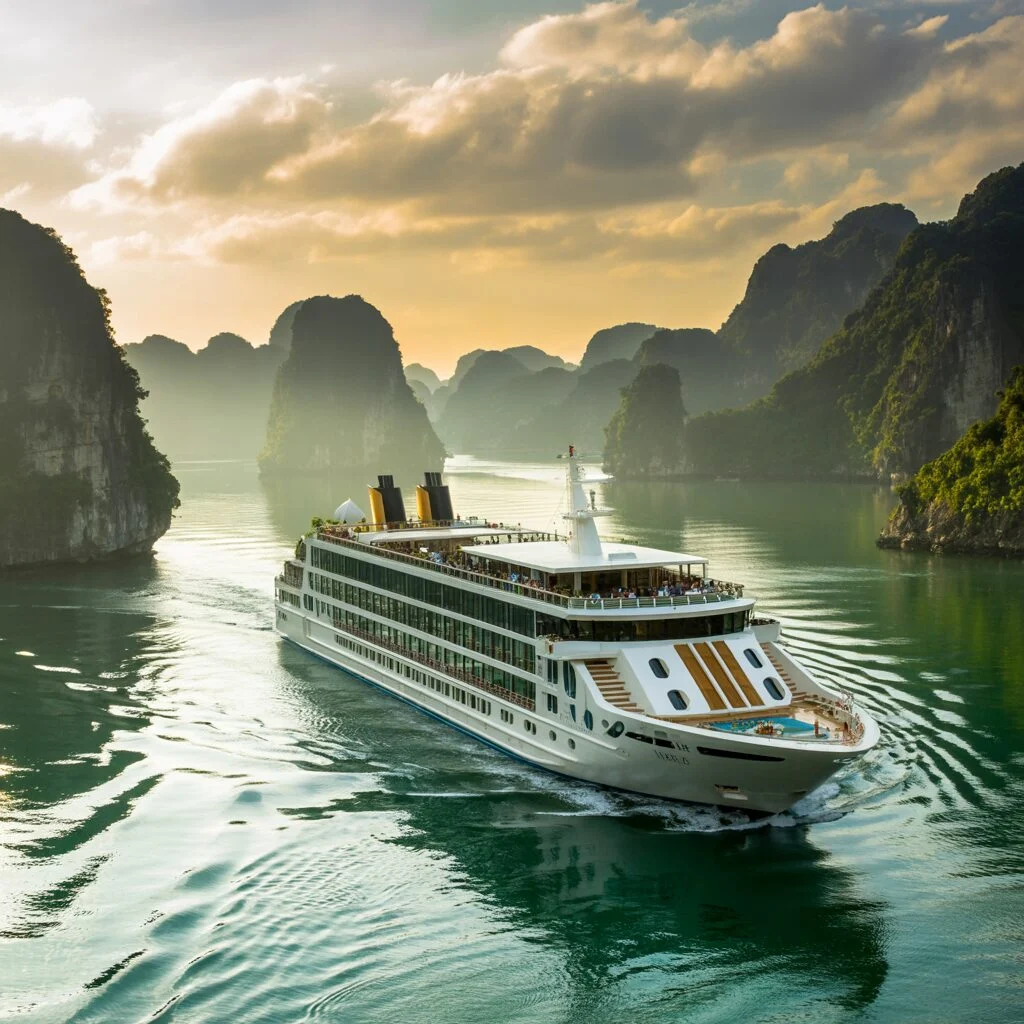
When comparing a Halong Bay vs Bai Tu Long Bay cruise, your choice depends on crowd tolerance. Halong Bay offers bustling experiences with 8,000-10,000 daily tourists. Bai Tu Long Bay provides a quieter alternative with only about 1,000 daily visitors and clearer water visibility of 7-9 meters.
This direct comparison evaluates crowd density, scenery, pricing, and itinerary structure to help US travelers prioritize their Southeast Asian marine excursions. Whether you prefer lively entertainment or secluded lagoons, understanding the operational differences between these Gulf of Tonkin cruises ensures you select the right overnight junk boat voyage for your 2026 travel plans.
Geography, Crowds & Scenery
A Halong Bay vs Bai Tu Long Bay cruise comparison begins with shared geography: both bays sit in the Gulf of Tonkin within the same UNESCO World Heritage designation, surrounded by approximately 2,000 limestone karst formations rising from emerald water. The divergence emerges in passenger density and environmental quality.
| Metric | Halong Bay | Bai Tu Long Bay |
|---|---|---|
| Daily tourist volume | 8,000-10,000 | ~1,000 |
| Boats visible at once | Hundreds (up to 30 per view) | 5-10 |
| Water visibility | 3-5 m | 7-9 m |
| Litter reported | Garbage floating | Zero |
The Halong Bay vs Bai Tu Long Bay cruise experience also splits scenically. Bai Tu Long’s Cap La area features narrow passages through tiny islets and hidden lagoons with completely still water. Beaches are typically empty, and kayaking through limestone passages yields crowd-free photography.
Why Is Bai Tu Long Bay So Quiet?
Bai Tu Long Bay was previously closed to all tour companies for years. The government then permitted only a handful of licensed operators to resume cruises, deliberately capping commercial access. This restricted-entry model contrasts with Halong Bay’s open-access framework, where hundreds of operators compete on mainstream mass-tourism routes.
Activities, Vessels & Operators
A Halong Bay vs Bai Tu Long Bay cruise diverges sharply in onboard programming. Halong Bay emphasizes lively entertainment – karaoke rooms, late-night DJ parties, and light-and-sound shows inside caves. Bai Tu Long Bay cruises prioritize authentic experiences: kayaking through limestone passages, squid fishing, optional sunrise Tai Chi on the sundeck, and Vietnamese coffee described as “next level of tasty.” The standard Bai Tu Long program includes cave exploring, beach visits, and cooking demonstrations.
Floating Fishing Village Visits
Bai Tu Long Bay’s Vung Vieng fishing village – 700 years old – is reached by traditional bamboo rowboat, featuring a floating school and families doing actual fishing work. Halong Bay’s floating villages, by contrast, are heavily oriented toward tourism. Kayaking is optional in Bai Tu Long, making it suitable for children and travelers physically unable to paddle.
Recommended Operators & Licensing
Only a handful of licensed operators serve Bai Tu Long Bay, where the government previously closed access to all tour companies for years. Key operators include Swan Cruises (2D/1N, sea-view cabins), Dragon Legend from the Indochina Junk fleet (luxurious, spacious cabins with bathtubs, spa, off-the-beaten-track routing), and Renea Cruises (boutique, covers both bays, widely considered best-value). Halong Bay’s open-access model allows hundreds of operators ranging from budget group ferry rides to 5-star vessels. This licensing cap directly shapes the quieter Bai Tu Long atmosphere.
Cost, Duration & Logistics
Halong Bay vs Bai Tu Long Bay cruise pricing starts nearly level: Halong overnight cabins run $100-130 (budget) while Bai Tu Long begins at $110-145. Transfers from Hanoi, taking 3.5-4 hours, are usually included in cruise packages. Traveler feedback flags 1-night cruises as too short; a 2-night tour is recommended for Bai Tu Long’s remote corners.
| Itinerary | Halong Bay | Bai Tu Long Bay |
|---|---|---|
| Overnight (budget) | $100-130 | $110-145 |
| Overnight (mid-range) | $130-160 | $140-200 |
| Overnight (higher-end) | $160-250 | $200+ |
| 3D/2N range | $200-550+ | $240-370 |
| Combo (both bays) | $135 | |
December adds 25-35% to prices; October and November stabilize without spiking.
Beverage Costs & Drink Packages
Onboard drinks cost extra on both bays. Beer runs $3-5; cocktails $5-8. Budget cruises often exclude transfers and drinks. The Cong Dam BBQ lunch provides no water; only sweet or alcoholic options for purchase.
Departure Ports Compared
Halong Bay vs Bai Tu Long Bay cruise logistics split by port: Halong vessels depart from Tuan Chau Marina, while Bai Tu Long cruises use Hon Gai port. Operator choice determines the port, and the 3.5-hour Hanoi-to-Halong drive extends slightly for Hon Gai.
Practicalities, Weather & Environment
US travelers need 220V Type A/C adapters, expect limited WiFi, and should visit between October and April for cooler, drier weather with clear views. May to September brings warmer temperatures, heavier rain, and storm risk. December sees a 25-35% price increase due to holiday demand, while October and November prices stabilize.
The Third Option: Where Does Lan Ha Bay Fit?
A Halong Bay vs Bai Tu Long Bay cruise comparison should account for Lan Ha Bay, located south of Halong Bay near Cat Ba Island. Lan Ha Bay is less crowded and less touristy than Halong, but offers fewer Day 2 activities than Bai Tu Long and returns to port sooner. Per TripAdvisor reports, there is no significant on-water experience difference among all three bays. Sena Cruise (same company as Swan Cruises) operates in Lan Ha Bay.
On-Board Practicalities for US Travelers
The Halong Bay vs Bai Tu Long Bay cruise experience requires preparation for Vietnam’s 220V Type A/C electrical system versus US 110V. Onboard WiFi is limited and intermittent on most vessels. Vegetarian, vegan, and gluten-free meals are usually available if requested in advance. Tipping $5-$10 USD or equivalent VND per cabin is appreciated but not mandatory. The Vietnamese government eliminated 92% of single-use plastics since 2023, though enforcement varies by operator.
FAQ: Halong Bay vs Bai Tu Long Bay Cruise
Do US citizens need a Vietnam visa for a 2026 cruise?
Yes. US citizens need a 90-day Vietnam e-visa costing around $25 USD, with processing typically taking 3 to 5 business days. This e-visa covers the entire country, including both Halong and Bai Tu Long bays. You can apply through the Vietnamese immigration portal as an external source.
Is there WiFi on the cruise?
WiFi availability is limited or intermittent on most cruises and is not guaranteed. Travelers should plan to disconnect during their overnight cruise duration. If staying connected is critical, check with specific cruise operators beforehand, but expect connectivity to drop in remote corners like Bai Tu Long National Park.
Can the cruise accommodate dietary restrictions?
Yes, vegetarian, vegan, and gluten-free options are usually available if requested in advance. Bai Tu Long cruises generally feature genuinely good Vietnamese food, including fresh seafood and multi-course dinners. Inform your operator of any dietary needs before departure to ensure the onboard dining itineraries meet your requirements.
What happens if there’s a storm and the cruise is canceled?
Port authorities may close the bay during severe storms, forcing cancellations. Operator refund versus rebooking policies vary, so travel insurance is recommended for US visitors. Activities may also be canceled due to weather. Always review the operator’s specific cancellation terms before booking your 2026 trip.
What should I pack for a Vietnam bay cruise?
Pack light clothing for warm days, a jacket for cool mornings and evenings, swimwear, sunscreen, and insect repellent. US travelers should bring a 220V power adapter, USD cash for tipping and onboard purchases, motion sickness medication, and reef-safe sunscreen. Leave your suitcase in Hanoi and bring a small bag.
What plug type do the cruise cabins use?
Vietnam uses Type A and Type C plugs at 220V, compared to the US 110V standard. Travelers must bring a power adapter and a voltage converter for their electronics. Preparing for 220V Type A/C outlets ensures your devices stay charged throughout the overnight junk boat voyage.
Should I tip the cruise staff?
Tipping is not mandatory but is highly appreciated. The expected range is $5 to $10 USD or equivalent in VND per cabin. Cruise staff in Bai Tu Long are noted for being outstanding and never in a rush, making a tip a great way to recognize their service during your trip.
Can solo travelers book a cabin without a single supplement?
Single occupancy is available on some operators, but a single supplement often costs 25 to 50 percent of the cabin rate. Some operators offer cabin-share matching. During meals, solo travelers and small groups are usually seated together, providing a social environment for those traveling alone.
Is seasickness a problem on these cruises?
Bay waters are generally calm, but open sections can be choppy. Bring your own motion sickness medication, as boats may not stock it. Bai Tu Long Bay offers completely still water in quieter corners like Cap La, which can be smoother for seasickness-prone travelers compared to mainstream mass-tourism routes.
Should I book directly with the operator or use a platform like Viator?
Viator is mentioned as a booking platform for Bai Tu Long cruises. Direct booking with operators may offer more flexibility for changes. Compare prices, filter Halong vs Bai Tu Long cruise accommodations, and review cancellation terms on both platforms before deciding to ensure the best value for your itinerary.