


Understanding the visa requirements for Vietnam beach vacation planning in 2026 is crucial for US citizens. You must obtain a Vietnam e-Visa prior to departure, which allows a 90-day stay. Your passport needs six months of validity beyond your exit date.
Additionally, travelers must submit a mandatory digital pre-arrival declaration within 72 hours before landing at major coastal hubs. While travel insurance and routine CDC vaccinations like Hepatitis A and Typhoid are highly recommended, there are absolutely no COVID-19 entry restrictions or testing mandates in place for US passport holders.
The e-Visa application costs $25 for a single entry or $50 for multiple entries and takes 3 to 5 business days to process. To avoid denied boarding, ensure every character on your application matches your passport exactly and carry printed copies of all required documents.
Last updated: October 2026. Our editorial team of travel documentation specialists reviews this guide quarterly against the Vietnam National Electronic Visa System and US Department of State travel advisories for Vietnam.
Do US Citizens Need a Visa for a Vietnam Beach Vacation in 2026?
US passport holders must have a Vietnam e-Visa before departure; the only exception is Phu Quoc’s 30-day visa exemption, which carries three strict conditions.
Vietnam grants 45-day visa-free entry to citizens of 24 eligible nations, but US passports are not on that list, so a visa is mandatory for every Vietnam beach vacation. The 90-day e-Visa is the standard route for US travelers.
The Phu Quoc 30-Day Visa Exemption
Phu Quoc (PQC) is the only beach destination US citizens can enter visa-free, for up to 30 days, if all three conditions are met:
- Direct air or sea arrival and departure on the island.
- Proof of an onward ticket outside Vietnam within 30 days.
- No entry prohibition on record.
Transiting through any other Vietnamese city voids the exemption, so book a nonstop flight to PQC.
| Feature | Phu Quoc Exemption | 90-Day E-Visa |
|---|---|---|
| Maximum stay | 30 days | 90 days |
| Government fee | None | $25 single / $50 multiple |
| Application | Not required | Online, 3 to 5 business days |
| Key condition | Direct flight plus onward ticket | Passport valid 6 months |
Passport Validity and the 72-Hour Digital Arrival Card
The six-month passport validity rule is strictly enforced for every Vietnam beach vacation: US passports must be valid for at least 6 months beyond the planned departure date from Vietnam, with at least 1 blank visa page.
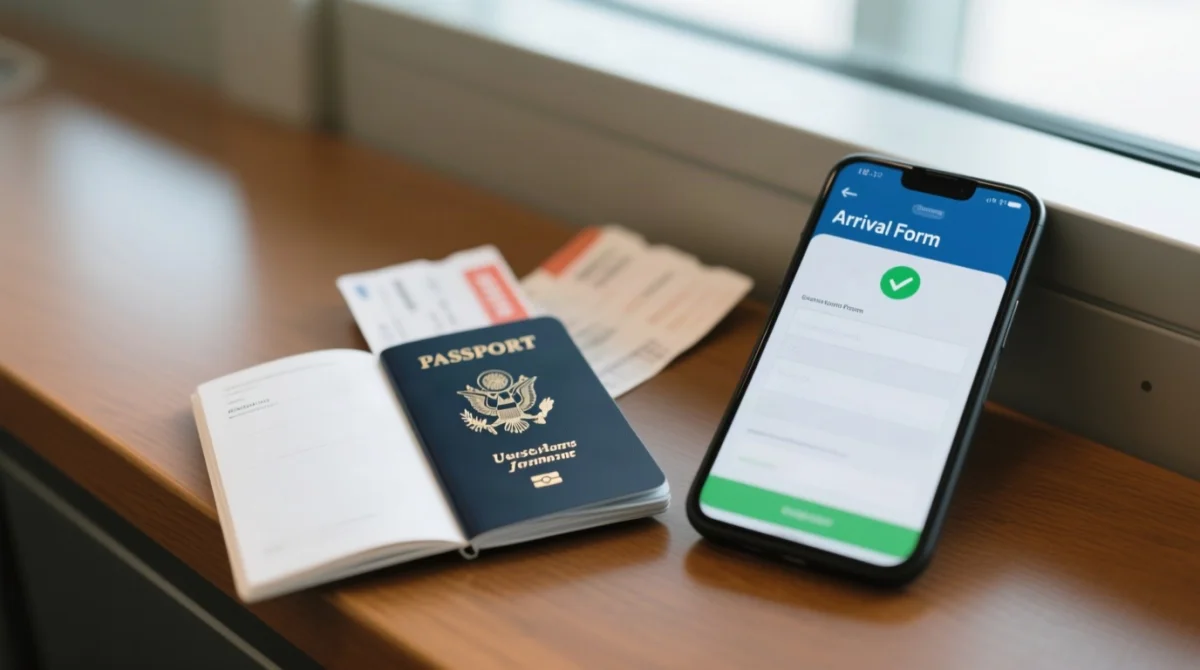
The passport must also have been issued within the past 10 years, and US travelers must show proof of onward travel, such as an exit ticket, at check-in and entry.
Airline staff compare your passport number and full name with the e-visa exactly character-for-character; even a single typo (for example, “Jon” versus “John”) causes mandatory denial at check-in.
Vietnam’s Digital Pre-Arrival Declaration in 2026: The Arrival Card Explained
All travelers must complete Vietnam’s digital pre-arrival declaration within 72 hours before arrival at five major airports: SGN, HAN, DAD, CXR, and PQC.
The arrival card is a mandatory digital form, and an approved e-visa is a strict prerequisite: the form becomes available only once your e-visa is approved and you have a valid QR code from the eVisa system. The old paper arrival forms are obsolete in 2026. Submit through the external government portal at evisa.gov.vn.
For a Vietnam beach vacation, complete the declaration inside the 72-hour window before your flight lands at Da Nang, Cam Ranh, or Phu Quoc, then print the QR code for border control.
How to Apply for a Vietnam e-Visa in 2026: Steps and Fees
The 90-day Vietnam e-Visa costs $25 USD for a single entry or $50 USD for multiple entries, with a standard processing time of 3 to 5 business days.
According to the Vietnam National Electronic Visa System, the external government portal, turnaround times are not guaranteed, so US travelers should apply at least 8 days before departure. Third-party services charge higher totals, often $72 to $121, for the same visa.
- Upload your digital passport data page and biometric photo.
- Complete the form, selecting your entry date and one of the 42 designated ports (13 airports, 16 land borders, 13 seaports).
- Pay the $25 or $50 government fee.
- Print the approved e-visa letter for travel.
On our most recent Vietnam beach vacation, a printed e-visa copy kept the immigration line at Da Nang moving; carry a physical backup in your carry-on rather than a phone screenshot.
E-Visa Photo Requirements
The e-visa photo requires a plain background and no glasses, uploaded in the specified digital dimensions.
Data Accuracy
Data mismatch is the number one reason airlines deny boarding to US travelers. Your full name, date of birth, and passport number must match the physical passport character-for-character, and your entry date must fall on or after the start date printed on the e-visa.
Health Documents: Travel Insurance, Vaccines, and COVID-19 Rules
COVID-19 documents are no longer required in 2026, but travel insurance and CDC-recommended vaccinations remain highly recommended for US travelers visiting Vietnam’s beaches.
COVID-19 Documents for Vietnam Entry in 2026
As of 2026, Vietnam requires no COVID-19 vaccine card and no PCR test. There is no mask mandate, no health declaration, and no quarantine requirement for any arriving passengers.
Insurance and Vaccination Guidelines
Travel insurance is recommended, not a mandatory visa condition; a policy should cover medical evacuation and COVID-19 treatment. CDC recommendations for coastal destinations include Hepatitis A and Typhoid. Book travel clinic appointments exactly 4 to 6 weeks ahead: Hepatitis A requires two doses 6 months apart, and Typhoid is a single shot 2 weeks before travel. A Yellow Fever certificate applies only if you arrive from an endemic country.
Prescription Medication Rules
Vietnam caps prescription medications at a 30-day supply. Carry them in original packaging with a signed doctor’s note matching your passport exactly.
Matching Your Visa Duration to Vietnam’s Beach Seasons in 2026
Visa duration depends on beach season: Phu Quoc peaks November to March under the 30-day exemption, while Da Nang is best February to May on the 90-day e-visa.
Vietnam’s coastal beaches have offset monsoon seasons, so US travelers should match visa length to each destination’s dry weather window before booking.
Airport Checks and Beach-Relevant Entry Points
The e-visa system supports 42 entry points. For a Vietnam beach vacation, US travelers select designated hubs like DAD (Da Nang), CXR (Cam Ranh), and PQC (Phu Quoc) when applying.
| Beach Destination | Peak Season | Airport Code | Maximum Stay |
|---|---|---|---|
| Phu Quoc | November to March | PQC | 30 days |
| Da Nang | February to May | DAD | 90 days |
The Complete 2026 Entry Checklist and Customs Rules
At border control, US travelers present these 6 documents; overstaying the approved dates triggers heavy fines and deportation.
- Passport: Valid at least 6 months beyond departure, with 1 blank visa page.
- E-visa: Printed copy of the approved letter.
- Digital arrival card: QR code issued within 72 hours before arrival.
- Onward travel and lodging: Exit ticket and hotel booking confirmation.
- Prescription medications: Maximum 30-day supply, original packaging, signed doctor’s note.
- Health documents: Travel insurance proof and CDC-recommended vaccination certificates.
Beach travelers must leave e-cigarettes, vapes, and drones at home: customs confiscates them on the spot, and penalties include fines up to $2,000 USD and possible deportation.
For emergency support, US travelers can contact the US embassy or consulate in Vietnam, and should monitor the US Department of State travel advisory for Vietnam, an external government source.
FAQ: Documents, Costs and Entry Rules for Vietnam Beach Travelers
Do US citizens need visas to travel to Vietnam beaches in 2026?
Yes. US citizens must hold a Vietnam e-Visa before departure. The only exception is Phu Quoc’s 30-day visa exemption, which requires a direct flight, an onward ticket within 30 days, and no transit through other Vietnamese cities.
What is the maximum stay on a Vietnam e-Visa?
The maximum stay is exactly 90 days. This applies to both single and multiple entry visas for US citizens, leaving ample time to explore coastal destinations across offset monsoon seasons.
How much does the Vietnam e-Visa cost for US travelers?
The government fee is $25 USD for single entry and $50 USD for multiple entry. Third-party services often charge $72 to $121, but the base government cost stays fixed.
What is one of the biggest mistakes you can make with a Vietnam e-Visa?
A data accuracy error. Your full name, date of birth, and passport number must match your passport character-for-character. Even one typo means the airline denies you boarding.
Are COVID-19 vaccination certificates required for Vietnam in 2026?
No. Vietnam requires no vaccine card, no PCR test, and no mask in 2026. Standard CDC vaccinations like Hepatitis A and Typhoid remain recommended for beach travel.
Is travel insurance mandatory for a Vietnam beach vacation?
Travel insurance is recommended, not mandatory. It should cover medical evacuation and COVID-19 treatment in coastal areas.
Can US citizens get a Vietnam Visa on Arrival?
No. A Visa on Arrival is restricted to narrow emergencies or transit from countries without a Vietnamese mission. Standard beach tourists must apply for the e-Visa online 3 to 5 business days ahead.
What happens if I overstay my Vietnam e-Visa?
Overstaying is a serious immigration violation. Penalties include heavy administrative fines and immediate deportation. Keep your exit date inside the approved 90-day window.