

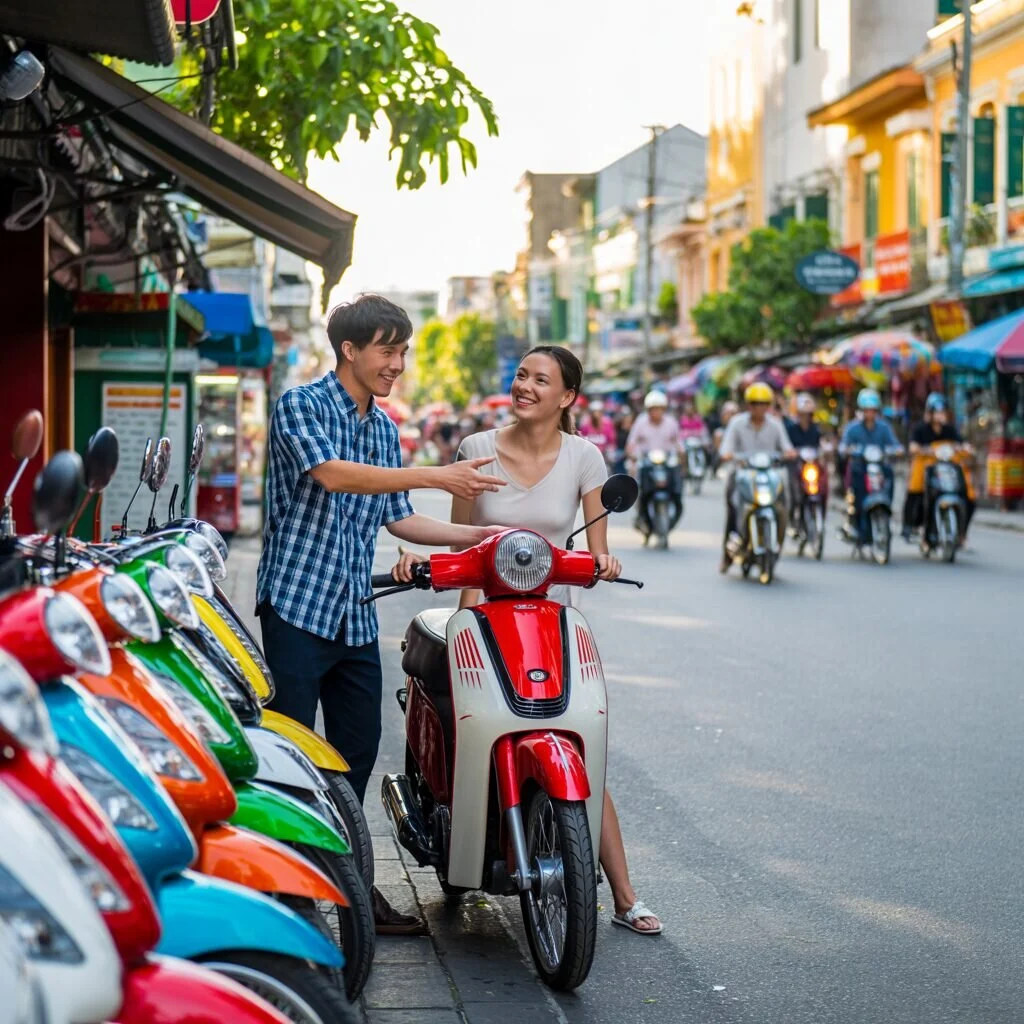
Figuring out how to rent a motorbike in Vietnam in 2026 comes down to costs and documents: $5-$14 (120,000-350,000 VND) per day, a valid passport with a visa stamp, and a 1968 Vienna Convention IDP for legal riding.
Prepare a $50-$200 (1,000,000-5,000,000 VND) cash deposit, never your original passport. Demand a written rental agreement and insist on 24-hour billing instead of calendar days. Monthly rates drop to $100-$180 (2,500,000-4,500,000 VND). For a full overview of all transport options, see our guide to transportation in Vietnam for tourists.
US travelers face one legal hurdle: the standard US-issued 1949 Geneva Convention IDP is not legally recognized for engines above 50cc. Only a 1968 Vienna Convention IDP with Category A keeps your ride legal and your insurance valid.
Where to Rent and How Much It Costs in 2026
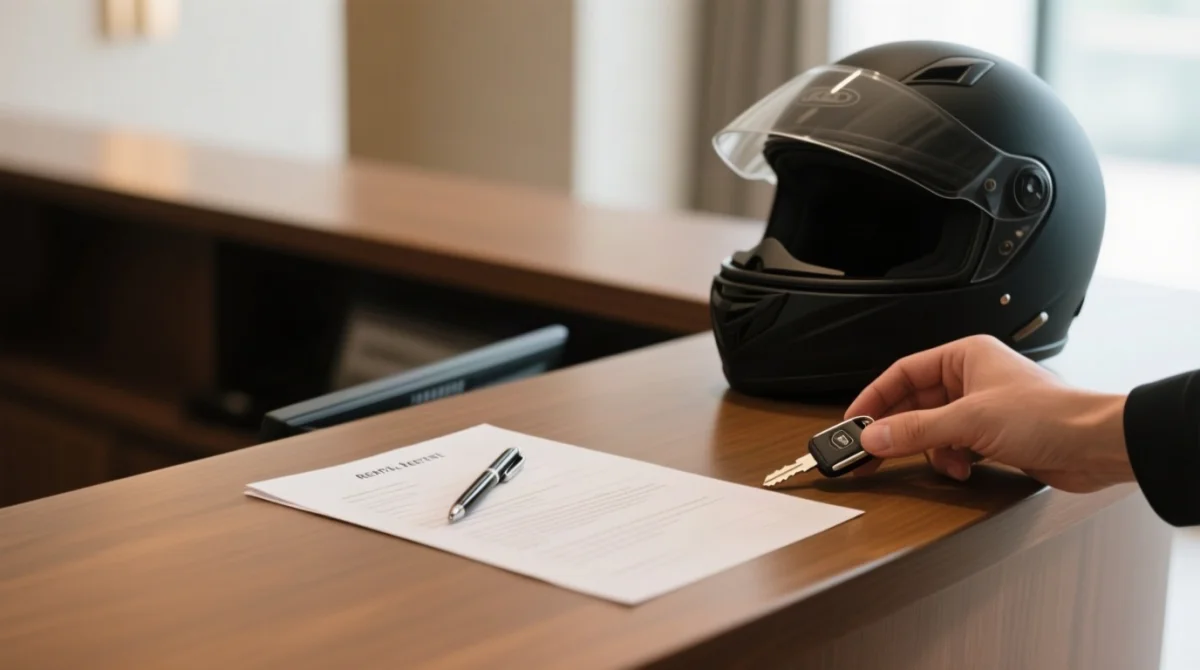
Motorbike rental in Vietnam costs 120,000-350,000 VND ($5-$14) daily or $100-$180 (2,500,000-4,500,000 VND) monthly. Rent from established chains or hotel desks rather than street shops to ensure clear contract terms.
Price Benchmarks by City
Daily rates: $5-$14 (120,000-350,000 VND); monthly: $100-$180 (2,500,000-4,500,000 VND). Hanoi and Ho Chi Minh City offer the most competitive monthly rates. For a broader breakdown of all travel expenses, check our transportation cost guide for Vietnam.
Decision Matrix: Which Rental Option Fits Your Trip?
Motorbike rental in Vietnam runs through three vendor channels: hotel desks (20-30% markup, safest), established chains (standard rates, written contracts), and backpacker shops (cheapest, higher risk). If self-driving is not for you, using Grab in Vietnam is a convenient ride-hailing alternative for short and medium trips.
| Rental Channel | Price Impact | Trade-off |
|---|---|---|
| Hotel Desks | 20-30% markup | Safest option but more expensive. |
| Established Chains | Standard rates | Provides reliable written contracts. |
| Backpacker Shops | Cheapest rates | Higher risk of vague terms and poor maintenance. |
Do You Need a License? The Legal Reality Check
Vietnam only recognizes 1968 Vienna Convention IDPs with Category A/A1. US-issued 1949 Geneva Convention IDPs do not legally cover motorbikes above 50cc.
Geneva vs. Vienna Convention IDPs
Legal motorbike rental in Vietnam requires specific documentation. US tourists typically hold an international driver’s license (IDP) under the 1949 Geneva agreement, which is legally void in Vietnam for standard motorcycles. Riders must possess a 1968 Vienna Convention IDP with a Category A endorsement. Riding without valid documentation voids insurance policies and risks a 100,000-200,000 VND fine at police checkpoints. Vietnam also strictly enforces a 0.0% blood alcohol limit for all riders. For a detailed look at road safety and riding conditions, read our guide on whether it is safe to drive a motorbike in Vietnam. Before you fly, verify the current IDP recognition list on the Vietnamese Ministry of Transport’s government portal.
| IDP Type | Legal Status in Vietnam | Vehicle Restriction |
|---|---|---|
| 1968 Vienna Convention | Valid | All engine sizes (with Category A) |
| 1949 Geneva Convention (US-issued) | Invalid | Limited to 50cc maximum |
Renting Without an IDP: 50cc Exemptions
Unlicensed tourists still have legal options for motorbike rental in Vietnam. National traffic laws exempt riders of 50cc scooters from needing an IDP. Electric bikes operating under 4 kW and capped at 50 km/h bypass the license requirement completely.
Choosing the Right Motorbike or Scooter
Automatic 125cc scooters suit beginners, semi-automatics handle mixed terrain, and manual 150-300cc bikes require valid licenses and experience.
Automatic vs. Semi-Automatic vs. Manual
Motorbike rental in Vietnam requires selecting a vehicle matching your skill level. The Yamaha Nouvo offers a fully automatic transmission ideal for beginners. The Honda Blade provides semi-automatic control for mixed gradients. For experienced riders, manual adventure motorcycles like the Honda XR150 or Kawasaki Versys X300 deliver necessary power but demand strict license compliance.
| Type | Model Example | Transmission | Best For |
|---|---|---|---|
| Automatic | Yamaha Nouvo | Fully Automatic | Beginners |
| Semi-Automatic | Honda Blade | Semi-Automatic | Mixed Terrain |
| Manual | Honda XR150 | Manual | Adventure Riders |
Long-Term Rentals and Luggage Racks
A successful motorbike rental in Vietnam depends on practical cargo solutions. Extended trips demand verifying a sturdy luggage rack, locally known as a baga. Avoid the used Honda Win, a manual bike notorious for frequent breakdowns on long routes.
How to Rent a Motorbike in Vietnam: The 7-Step Process
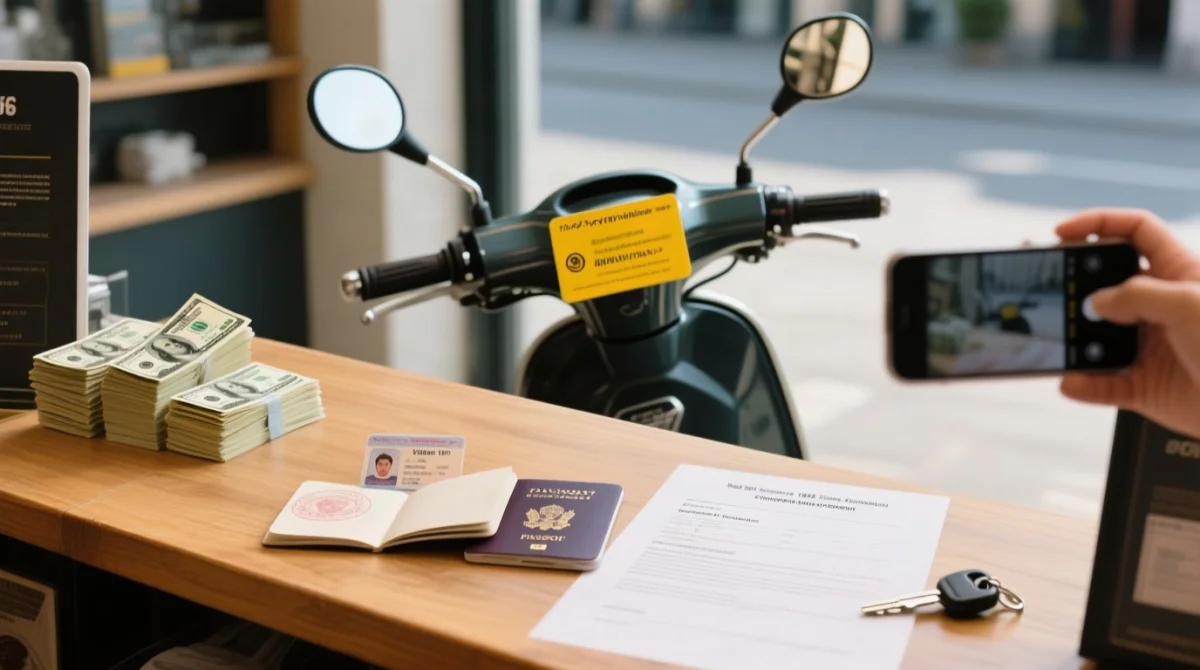
These seven steps, executed in order, protect your motorbike rental in Vietnam from hidden fees and voided insurance.
Select a vendor
Choose one that provides a written, bilingual rental agreement.
Present your documents
Provide your valid passport, visa stamp, and 1968 Vienna Convention IDP.
Insist on 24-hour billing
Choose a 24-hour billing cycle rather than calendar-day billing to avoid overpaying for partial days.
Provide collateral
A standard motorbike rental in Vietnam requires a $50-$200 (1,000,000-5,000,000 VND) cash deposit. Never leave your original passport with the operator.
Verify the insurance
Check for the mandatory yellow third-party liability card under the seat.
Execute a pre-rental inspection
Take a block test ride to check the brakes and engine, and confirm the scooter has exactly two rearview mirrors to comply with traffic laws.
Photograph the vehicle
Take photos from all angles to document pre-existing scratches before signing the contract.
Rental Agreements and Insurance: Red Flags to Check
Motorbike rental in Vietnam involves strict contractual terms. Watch for missing written contracts, calendar-day billing, original passport retention, and missing compulsory third-party liability insurance (TNDS). For tips on spotting and avoiding common transport fraud, see our guide on how to avoid taxi scams in Vietnam.
- No written rental agreement or contract provided.
- Calendar-day billing instead of a 24-hour cycle, charging two days for an overnight rental.
- Vague damage liability clauses.
- Demands to retain your original passport.
- Missing TNDS yellow card under the seat.
- No pre-existing damage documented.
- Unclear fuel policy.
- Shop insurance coverage excluding unlicensed riders.
- Hidden mileage limits.
- Cross-province travel restrictions.
Deposit and Collateral: Cash Hold vs. Passport Retention
A standard security deposit for motorbike rental in Vietnam is $50-$200 (1,000,000-5,000,000 VND) in cash. Never leave your original passport as collateral; provide a notarized passport copy instead.
Vietnam’s Compulsory Third-Party Liability Card (TNDS)
Vietnamese law requires a valid TNDS yellow card stored under the seat, providing basic third-party liability protection. Any additional shop insurance coverage is automatically void if you ride without a legally recognized license.
Before You Ride: Inspection, Fuel, and Practical Prep
Pre-rental basics for motorbike rental in Vietnam: photograph existing damage, test the brakes over one block, and fill standard automatic scooters with E5 RON 92.
Pre-Rental Inspection Checklist
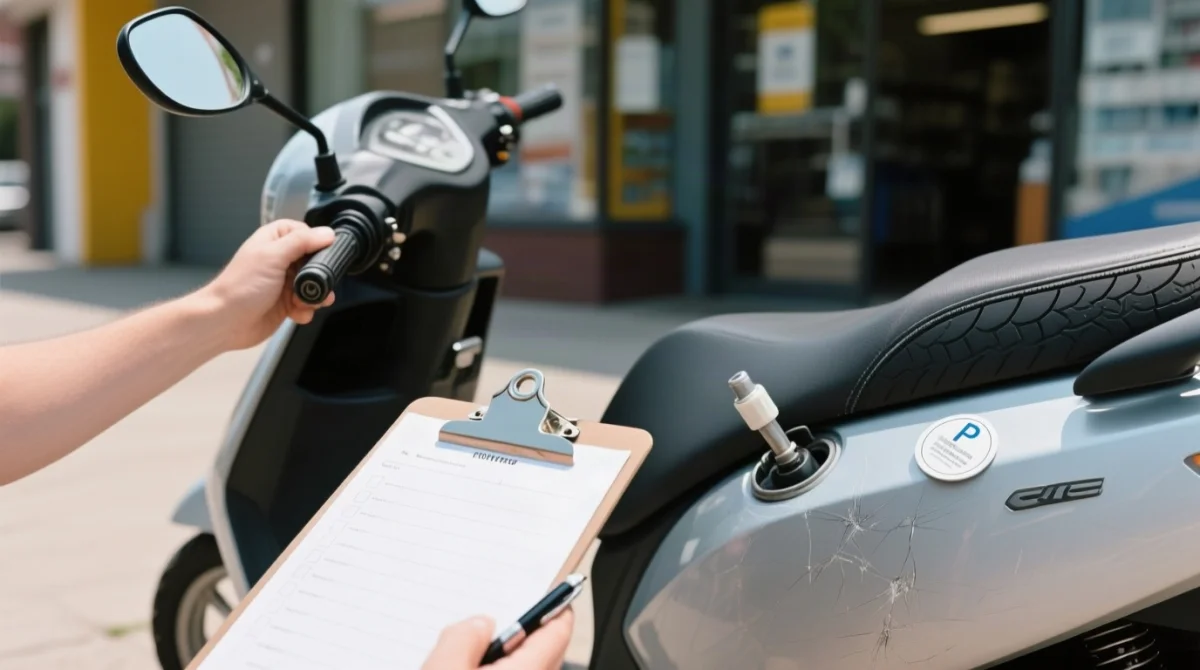
Inspection checklist for motorbike rental in Vietnam: 2 rearview mirrors, tire tread, engine idle, test drive.
- Ensure exactly two rearview mirrors to comply with local traffic laws.
- Inspect tire tread depth and listen to the engine idle.
- Take a short test drive to verify brake responsiveness.
Fuel Grades and Parking (Vé Giữ Xe)
Fill standard scooters with E5 RON 92 and manual adventure motorcycles with RON 95. Download offline maps for navigation. At markets and shops, attendants issue a Vé Giữ Xe parking token; keep it secure to retrieve your scooter.
Staying Legal and Safe While Riding in Vietnam
Vietnamese traffic law enforces a 0.0% blood alcohol limit, bans motorbikes from expressways, and issues 100,000-200,000 VND fines at checkpoints.
Traffic Police Stops and Fines
If traffic police stop your motorbike rental in Vietnam, turn off the engine, remove the keys from the ignition, and present your documents. Minor infractions often result in on-the-spot fines of 100,000-200,000 VND.
Expressway Restrictions and Emergency Numbers
A standard motorbike rental in Vietnam strictly prohibits riding on national expressways (cao tốc) because two-wheelers are legally banned from these routes. For accidents requiring roadside assistance or emergency services, dial 113 for police, 114 for fire, and 115 for an ambulance.
Frequently Asked Questions (FAQ)
Can foreigners rent bikes in Vietnam?
Yes. Motorbike rental in Vietnam requires a valid passport, visa stamp, and a cash deposit or notarized passport copy; engines over 50cc also demand a 1968 Vienna Convention IDP (Category A).
Do I need a motorcycle license to rent in Vietnam?
Yes, over 50cc you need a home motorcycle license plus a 1968 Vienna Convention IDP. The US-issued 1949 Geneva IDP does not qualify; 50cc bikes and electric scooters under 4 kW are exempt.
How much is the deposit for motorbike rental in Vietnam?
The standard security deposit for motorbike rental in Vietnam is $50-$200 (1,000,000-5,000,000 VND) in cash, depending on the vehicle and contract terms. Some shops accept a notarized passport copy instead.
Should I leave my passport as a deposit?
No. Never leave your original passport; retention demands are a red flag. Secure your motorbike rental in Vietnam with a $50-$200 cash deposit or a notarized passport copy.
What happens if I get pulled over by traffic police?
Turn off the engine, remove the keys, and present your 1968 Vienna Convention IDP, home license, Blue Card, and TNDS insurance. On-the-spot fines run 100,000-200,000 VND under the 0.0% blood alcohol limit.
Is one-way motorbike rental possible in Vietnam?
Yes. Established chains allow pickup in one city and drop-off in another, popular on the Hoi An-Hue route over the Hai Van Pass; a one-way taxi there costs $50-$70 for comparison. For those who prefer rail travel, booking train tickets in Vietnam is another popular option for this route.
What fuel should I put in my rented scooter?
Standard automatic scooters use E5 RON 92; manual bikes like the Honda XR150 need RON 95. Budget $2-$4 (30,000-60,000 VND) per day for fuel.
Does my travel insurance cover motorbike accidents in Vietnam?
Often not. Riding illegally with the invalid 1949 Geneva IDP over 50cc can void personal policies, and the local TNDS card excludes unlicensed riders.
Can I ride a motorbike on the expressway in Vietnam?
No. Two-wheelers are banned from national expressways (cao tốc); use national highways and local roads instead. Violations draw heavy penalties at checkpoints.
What should I do if my rented motorbike breaks down?
Call the rental shop first for roadside assistance; save its contact number before signing. For severe emergencies, dial 113 for police, 114 for fire, or 115 for an ambulance.
Last updated: October 2026. This guide reflects independent research and has no affiliation with any rental operator.