
Planning what to pack for Vietnam in 2026 means prioritizing lightweight, quick-dry clothing for tropical humidity, a modest sarong for temple visits, waterproof hiking boots for Sapa treks, and a universal adapter for 220V Type A/C/F outlets. Add DEET repellent, an activated eSIM, and a secure money belt for Vietnamese Dong.
Understanding the regional climate variations is essential when deciding what to pack for Vietnam. Northern regions like Sapa experience cold temperatures requiring thick, warm socks and a warm water/windproof jacket, while southern areas remain warm and humid year-round. Opt for a capsule wardrobe strategy using quick-dry moisture-wicking fabric to accommodate both environments.
Beyond clothing, prioritize health and connectivity. Pack SPF 30+ sunscreen, alcohol-based hand sanitizer, and a first-aid kit for trips longer than a week. Verify that your passport is valid for at least six months and apply for your $25 e-visa online three business days before departure. Use compressible packing cubes to organize your bag within the 12 kg carry-on weight restrictions for domestic flights.
Seasonal Clothing & Cultural Dress Considerations
Deciding what to pack for Vietnam means assembling a capsule wardrobe of quick-dry cotton or linen layers, a warm pullover for Sapa, a packable rain jacket for monsoon season, and a sarong for temple visits.
Winter (Dec-Feb)
Northern Vietnam gets quite cold; Sapa can snow, requiring a pullover or jacket. Southern and central regions stay warm by day.
Summer/wet (Jun-Aug)
Monsoonal rains fall most afternoons. Prioritize a packable rain jacket and fast-drying fabrics.
Spring & autumn
April-May and September-October are mild; March and November mirror each other with lower humidity.
- Capsule quantities: For a practical answer to what to pack for Vietnam, limit yourself to 3-4 tops, 2-3 bottoms, and 1 compact rain layer. Laundry costs about 25,000 VND ($1) per kilo.
- Temple dress code: No sleeveless shirts; shorts and dresses must cover the knee, applying to both men and women. A sarong or modesty wrap covers shoulders at religious sites.
- Temple-friendly attire & footwear: Midi-length skirts, culottes, and wide-leg trousers stay breathable while complying. Flip-flops slip off easily at temples.
Trekking Gear & Footwear for Sapa and Phong Nha
For trekking Sapa and Phong Nha, pack waterproof hiking boots, quick-dry socks, convertible hiking trousers, a reusable water bottle with purification tablets, and a dry bag for water activities. Deciding what to pack for Vietnam trekking routes means accounting for Sapa’s highland climate, where January temperatures drop to 5-11°C and mountains stay cold year-round.
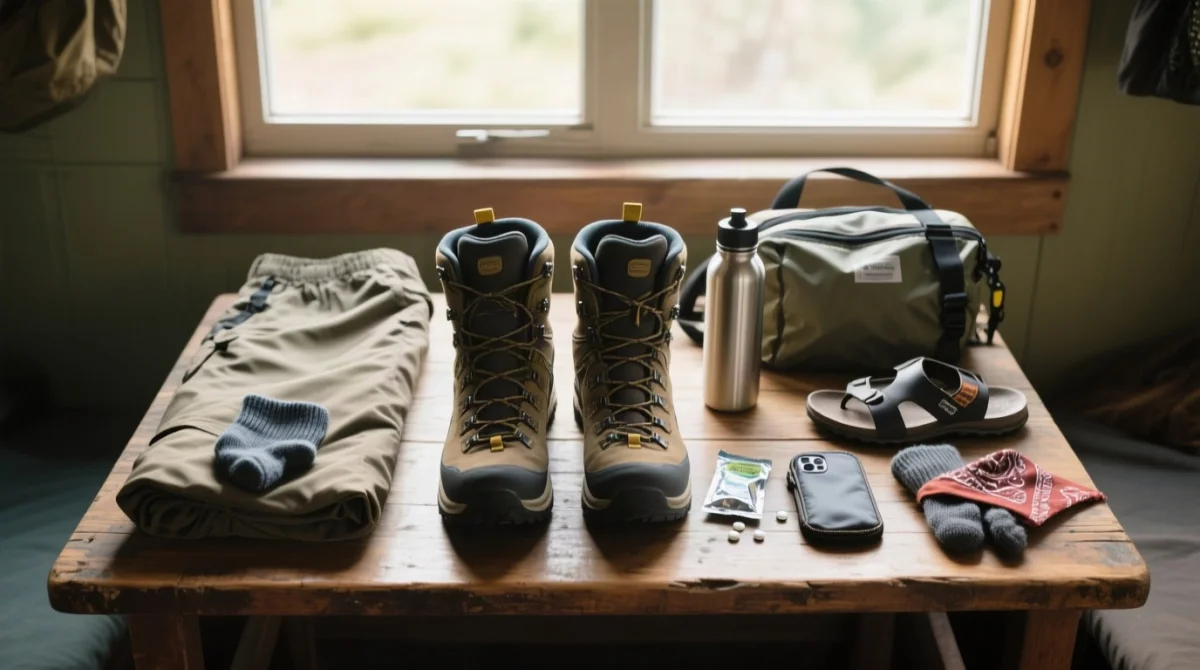
| Gear Type | Recommendation | Purpose |
|---|---|---|
| Hiking boots | Waterproof, sturdy, comfortable | Sapa trails, Phong Nha limestone karsts |
| Sandals | Water-resistant Chacos, adjustable | Day tours; more secure than flip flops |
| Trousers | Convertible hiking trousers | Countryside trips |
| Cold layers | Thick socks, gloves, scarf, hat | Northern Vietnam highlands |
| Face protection | Scarf or bandana | Dusty high-altitude winds |
| Water bottle | Refillable from hotel glass bottles | Reduce plastic waste |
| Purification | Water purification tablets | Camping or remote areas |
| Dry bag | Waterproof | Water activities |
| Phone pouch | Waterproof | Ha Long Bay boat rides, downpours |
Knowing what to pack for Vietnam adventure zones also means packing light for overnight Ha Long Bay junk boat cruises: leave suitcases behind.
Tech, Adapters, Voltage & Connectivity
What to pack for Vietnam includes a universal adapter (Type A/C/F) with surge protection, a voltage converter for non-dual-voltage devices, and an activated eSIM or Viettel SIM card. Vietnam’s outlets run at 220V/50Hz, not US 110V/60Hz. iPhone chargers are dual-voltage compatible; hair dryers require a converter.
| Feature | eSIM | Physical SIM |
|---|---|---|
| Setup | Activate before arrival | Buy Viettel SIM at airport |
| Cost | Carrier plan dependent | 10GB prepaid |
| Remote coverage | Varies by provider | Viettel/Vinaphone recommended |
| Convenience | No physical swap | Requires tray swap |
What to pack for Vietnam also covers a power bank for sleeper trains, a waterproof phone case, spare batteries (local quality unreliable), and a small external hard drive for photo backup. Download Grab for taxi navigation.
Health, Sun & Insect Protection
Pack SPF 30+ sunscreen with UVA and UVB protection, DEET-based insect repellent, a basic first-aid kit, and use bottled water for dental hygiene since Vietnam’s tap water is unsafe to drink. What to pack for Vietnam must address intense sun and year-round dengue fever risk.
Apply DEET repellent morning and night across urban and rural zones; treat clothing with permethrin at home before departure. Reapply SPF 30+ sunscreen throughout the day from small travel bottles. Assemble oral rehydration salts, aloe gel, anti-itch cream, and bandages in multiple sizes. Add loperamide or bismuth subsalicylate for diarrhea, acetaminophen or ibuprofen for pain. Pack hand sanitizer with at least 60% alcohol.
Complete vaccinations ideally eight weeks prior to travel. Carry travel insurance and spare glasses. Deciding what to pack for Vietnam includes preparing prescriptions carefully.
OTC Medication Restrictions & Prescription Rules
Common US OTC medications containing codeine or pseudoephedrine may be restricted or illegal in Vietnam. Check the Vietnamese embassy restricted-substance list before departure and carry a doctor’s note with all prescriptions listing generic names.
Documents, Visas & Cash Logistics
US travelers need a passport valid for six months beyond arrival, a $25 USD e-visa processed in three business days, and a secure money belt for Vietnamese Dong at $1 = 25,000 VND. Deciding what to pack for Vietnam begins with documents: keep one passport photocopy at home and carry one on trip. Apply for the e-visa online and print it before arrival. Visa-free entry spans 15 to 30 days for some nationalities, with a three-month maximum.
Many establishments including street food stalls, homestays, and public restrooms accept cash only. Laundry costs 25,000 VND ($1) per kilo every 5 to 7 days; pack luggage padlocks accordingly.
Currency Exchange & Cash Handling Tips
ATM withdrawals yield roughly 3 million VND (~$100) per transaction. Agribank offers among the lowest fees; a Charles Schwab checking account refunds ATM fees worldwide. Carry small VND notes for markets. Pharmacies are common but labels are not always in English, so include essential medications when finalizing what to pack for Vietnam.
Tipping Etiquette & Baggage Allowances
While tipping is not mandatory in Vietnam, rounding up street food bills and tipping hotel housekeeping 20,000-50,000 VND is appreciated; pack within Vietnam Airlines’ 12kg carry-on limit using compressible cubes and anti-theft bags.
Knowing what to pack for Vietnam includes budgeting small-denomination VND for gratuities. Tipping is not traditional but increasingly appreciated across hospitality and transport services.
| Service | Tipping Norm | Expected Amount |
|---|---|---|
| Hotel housekeeping | Appreciated | 20,000-50,000 VND |
| Street food | Round up bill | Discretionary |
| Grab drivers | Not expected | Optional rounding |
| Restaurants | Small tip; service charge may apply | Discretionary |
| Tour guides | For good service | Discretionary |
| Spa/massage | Appreciated | Discretionary |
Packing Organization & Domestic Flight Liquid Rules
Deciding what to pack for Vietnam means respecting Vietnam Airlines’ 12 kg (26 lbs) carry-on limit across 2 bags, with internal flights allowing 20 kg checked and 5 kg hand luggage. Domestic carry-on enforces the 100ml liquid rule. Use compressible packing cubes, an AirTag for luggage tracking, and an anti-theft crossbody bag for Hanoi and Ho Chi Minh City markets. Pack a foldable day pack and travel light for overnight Ha Long Bay cruises.
Frequently Asked Questions (FAQ)
What should I pack for Vietnam in 2026?
You should pack a capsule wardrobe of lightweight, breathable fabrics like cotton or linen, a packable rain jacket for monsoon season, and a sarong for temple visits. Include a universal travel adapter for Type A/C/F outlets, DEET-based insect repellent, SPF 30+ sunscreen, a prepaid mobile SIM card or eSIM, and compressible packing cubes to maximize space.
What kind of power adapter do I need for Vietnam?
Vietnam uses Type A, C, and F plug types. You need to pack a universal travel adapter with surge protection to accommodate these outlets. A conversion plug is recommended for US travelers to ensure all electronic devices can be charged safely and efficiently upon arrival in Vietnam, preventing any connectivity issues during your trip.
Can I use my US electronics in Vietnam without a voltage converter?
Vietnam operates on 220V and 50Hz electricity, which differs from the 110V/60Hz standard in the USA. While many modern electronics like iPhone chargers are dual voltage, devices like hair dryers may require a voltage converter to prevent damage. Always verify your device specifications before plugging them into Vietnamese outlets.
Is tap water safe to drink in Vietnam?
Tap water in Vietnam is unsafe to drink. Travelers should use bottled water for dental hygiene and drinking. If you are camping or visiting remote areas, bring water purification tablets. A reusable refillable water bottle is recommended to refill from hotel glass bottles instead of buying plastic.
Are there restrictions on bringing over-the-counter medications to Vietnam?
Common US over-the-counter medications containing codeine or pseudoephedrine may be restricted or illegal in Vietnam. Check the Vietnamese embassy list before travel. Carry a doctor’s note for prescription medication, bring copies of all prescriptions including generic names, and avoid carrying large quantities of medications into the country.
Should I buy a physical SIM card or use an eSIM in Vietnam?
US travelers should activate an eSIM before arrival or buy a physical Viettel SIM card at the airport for reliable remote coverage. Viettel and Vinaphone are the most reliable networks for remote mountainous coverage. A 10GB prepaid SIM card is useful for navigating, using Google Maps, and ordering taxis with Grab.
What should I wear when visiting temples in Vietnam?
Dress conservatively when visiting temples and sacred spaces. Sleeveless shirts are not allowed, and shorts or dresses must cover the knee for both men and women. Pack a sarong or modesty wrap to cover your shoulders and knees. Midi-length skirts, culottes, and wide-leg trousers are excellent options for temple visits.
Do I need to tip in Vietnam, and how much is standard?
Tipping is not traditional or mandatory in Vietnam, but it is increasingly appreciated. For hotel housekeeping, a standard tip is 20,000 to 50,000 VND. Rounding up the bill is appreciated for street food. Grab drivers do not expect tips, but optional rounding up is welcome. Tour guides and spa staff appreciate discretionary tips.
What is the baggage allowance for domestic flights in Vietnam?
Vietnam Airlines allows a carry-on weight limit of 12 kg (26 lbs), divided into 2 bags including a personal item. Internal flights typically allow 20 kilos of checked luggage and 5 kilos of hand luggage. Domestic carry-on flights enforce the standard 100ml liquid restriction for toiletries.