

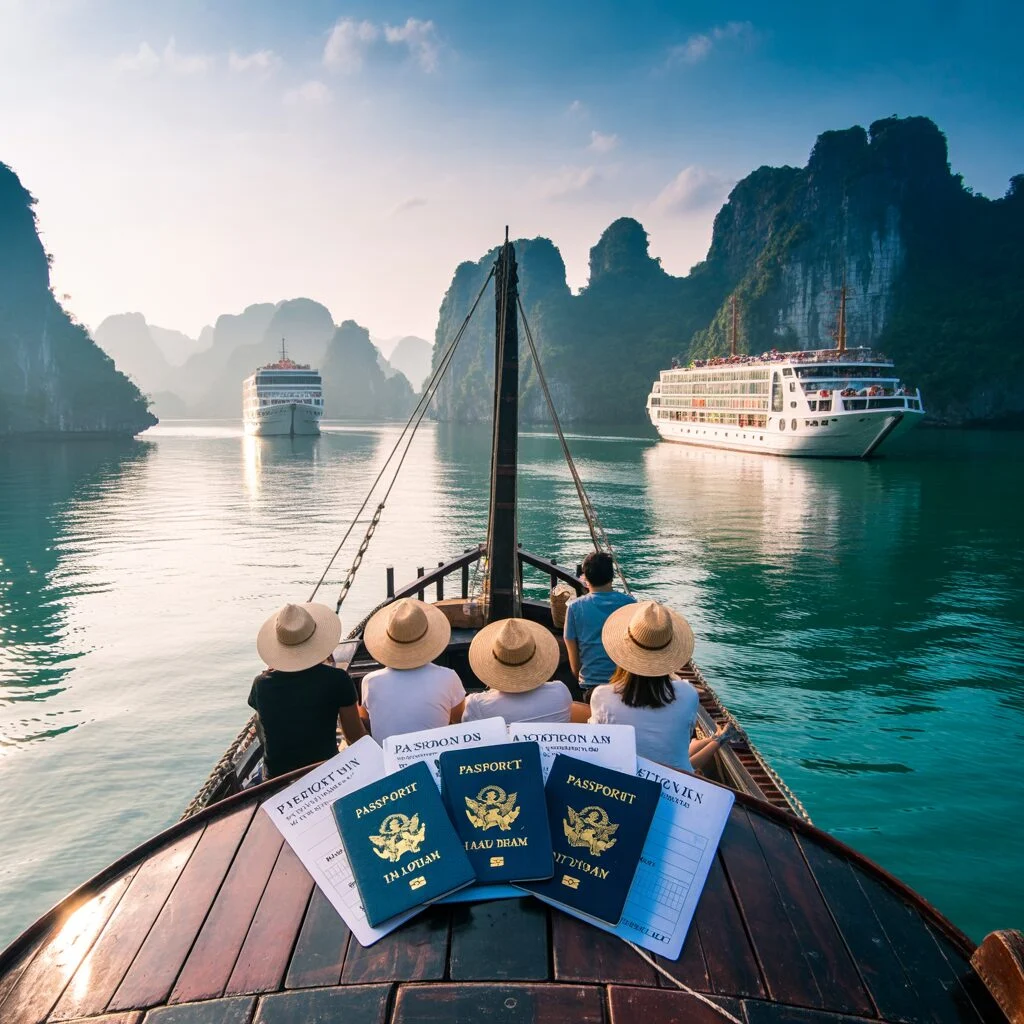
US citizens cruising to Vietnam in 2026 must secure a valid e-visa ($25 single-entry or $50 multiple-entry) or a ship-arranged visa before sailing. Passports must remain valid for at least six months beyond planned trip dates with two blank pages.
Depending on your specific itinerary, you may also need to present a digital pre-arrival form effective April 15, 2026. Additionally, securing travel insurance with medical evacuation coverage and specific vaccination certificates, such as Yellow Fever proof if arriving from an endemic country, is highly recommended for a seamless immigration clearance procedure.
This step-by-step guide breaks down the Vietnam cruise visa requirements for US citizens, covering independent e-visa applications, cruise line group visa logistics, health document preparation, and cross-border digital entry forms for multi-country Southeast Asia itineraries.
Do US Citizens Need a Visa for a Vietnam Cruise in 2026?
Vietnam cruise visa requirements for US citizens establish a non-negotiable baseline: American passport holders arriving by sea are not on the visa exemption list and must secure valid entry authorization before boarding.
Single-Entry vs. Multiple-Entry Visas for Cruises
A $25 single-entry e-visa suffices when an itinerary calls at multiple Vietnamese ports without exiting to a third country. A $50 multiple-entry e-visa is required if the route leaves Vietnam (e.g., to Cambodia) and re-enters by land, sea, or air.
Cruise Line Group Visas vs. Independent Applications
Most cruise lines arrange group visas for guests onboard. These ship-issued authorizations are often priced at $120 or more and remain valid only for arrival and departure on that specific vessel. Vietnam cruise visa requirements for US citizens permit an independent e-visa application as a cheaper alternative, provided the traveler selects the correct designated seaport during online submission.
Step-by-Step Guide to the Vietnam E-Visa Application
Vietnam cruise visa requirements for US citizens direct travelers to apply online via Vietnam’s immigration portal, paying $25 (single-entry) or $50 (multiple-entry), with processing taking 3-7 working days under GMT+7.
How to Apply for a Vietnam E-Visa Online
- Submit your application through the government portal at evisa.xuatnhapcanh.gov.vn or evisa.gov.vn.
- Fill in all personal details exactly as they appear in your passport and select the correct designated port of entry.
- Track your application at evisa.gov.vn/e-visa/search using your registration code.
- Download your e-visa approval PDF once approved and carry a printed copy for immigration clearance.
Vietnam E-Visa Processing Times & GMT+7 Window
Processing takes 3-7 working days under Vietnam Time (GMT+7), excluding weekends and Vietnamese public holidays. Vietnam cruise visa requirements for US citizens demand applying early enough to account for this timezone difference and avoid boarding denial.
E-Visa Photo Requirements & Common Rejections
Upload a passport photo sized 4×6 cm or digital equivalent. The image must be clear and not blurry. Incorrect personal information or unqualified photos are the primary causes of processing delays and rejections.
Navigating Designated Seaports and Transit Zones in Vietnam
Vietnam cruise visa requirements for US citizens restrict entry to 39 designated seaports, including Ho Chi Minh City, Hai Phong, Da Nang, Nha Trang, and Chan May. Passengers must enter only through the specific port listed on their approved e-visa during the immigration clearance procedure.
- Verify your approved e-visa port matches your cruise itinerary before sailing.
- Entry at a non-listed seaport triggers denial of disembarkation.
- Shore excursions returning to the same ship at the same port do not require a separate visa.
Loose-Leaf Visa on Arrival at Vietnam Seaports
For certain nationalities, a loose-leaf visa is available directly at Vietnam seaports. The cruise operator hands out an application form; passengers submit the form with their passport and pay the fee upon disembarking. The border officer issues the document, which becomes invalid after departure from Vietnam.
Vietnam Pre-Arrival Form (QR Code) Requirements
Vietnam cruise visa requirements for US citizens now include a digital pre-arrival form effective April 15, 2026. Travelers must generate a QR code prior to arrival and present it during port-side immigration checks.
Pre-Departure Health Insurance & Medical Checklist
Vietnam cruise visa requirements for US citizens extend beyond immigration authorization to include verified health documentation and travel medical insurance & evacuation coverage before terminal check-in.
- COVID-19: Proof of vaccination or negative PCR test is no longer required for US travelers.
- Yellow Fever: Mandatory if arriving from a country with risk of transmission.
- Recommended vaccines: Hepatitis A, Hepatitis B, Japanese encephalitis, Rabies, Typhoid.
- Prescription medication declaration: Carry prescriptions and a letter from your medical provider.
- Travel insurance: Maintain valid coverage for emergency health treatment, COVID-19 treatment, and medical evacuation.
Yellow Fever Vaccination Rules
Vietnam cruise visa requirements for US citizens mandate Yellow Fever vaccination proof only when travelers transit from endemic countries. Border health screening teams verify certificates at designated arrival terminals.
Routine & Destination-Specific Vaccines
US cruisers should obtain Hepatitis A, Hepatitis B, Japanese encephalitis, Rabies, and Typhoid immunizations before departure. A doctor’s letter must accompany all prescription medications to satisfy immigration clearance procedures at Vietnamese seaports.
Passport Readiness and Visa Requirements for Minors and Families
Vietnam cruise visa requirements for US citizens enforce the six-month passport validity rule, requiring passports to remain valid for at least six months beyond planned trip dates with a minimum of two blank pages. These Vietnam cruise visa requirements for US citizens also dictate that each family member secures individual entry authorization before sailing.
E-Visas and Consent Letters for US Citizen Minors
Every US citizen minor, including infants, must obtain a separate e-visa alongside a completed visa application form. For single-parent travel, Vietnamese authorities require birth certificates and notarized consent letters. Travelers facing documentation issues should seek advice from their respective US embassy, consulate, or travel agent.
Cross-Border Digital Entry Forms for Multi-Country Cruises
Multi-country Southeast Asia cruises require separate digital arrival forms: Thailand TDAC, Cambodia e-Arrival, and Singapore Arrival Card, each with distinct submission windows.
Vietnam cruise visa requirements for US citizens extend beyond a single entry permit when itineraries span multiple nations. Cross-border entry regulations now mandate that American cruisers complete a Digital Arrival Card for each country visited by sea. These forms are independent of any Vietnamese e-visa and must be filed through each country’s government portal before port arrival.
| Country | Form | Submission Window | Government Portal |
|---|---|---|---|
| Thailand | TDAC | Up to 72 hours before arrival | tdac.immigration.go.th |
| Cambodia | e-Arrival | Within 7 days prior to arrival | arrival.gov.kh |
| Singapore | Arrival Card | 3 days prior to arrival | eservices.ica.gov.sg |
Failure to submit any required Digital Arrival Card can delay disembarkation or trigger secondary immigration screening. Vietnam cruise visa requirements for US citizens assume travelers have satisfied all transit-country digital obligations before the ship docks.
FAQ: Vietnam Cruise Visa Requirements for US Citizens
Can US citizens get a Vietnam visa on arrival for a cruise?
A loose-leaf visa on arrival is available at Vietnam seaports for certain nationalities. The cruise operator hands out the application form, and you submit it with your passport and pay the fee upon disembarking. The border officer issues the document, which becomes invalid after departure. However, applying for an e-visa online beforehand is the primary digital authorization pathway.
How much does a Vietnam e-visa cost for US citizens in 2026?
A Vietnam e-visa costs $25 USD for a single-entry visa and $50 USD for a multiple-entry visa for US citizens in 2026. These independent e-visa fees are often considerably cheaper than ship-arranged group visas, which can cost significantly more through commercial facilitators.
Does my cruise line automatically arrange my Vietnam visa?
Most cruise lines can arrange group visas for guests. However, ship-issued visas are only valid for arrival and departure on that specific ship. While convenient, this option is often considerably more expensive than obtaining an independent tourist e-visa for $25 or $50.
What happens if my US passport expires in 5 months?
If your US passport expires in five months, you will not meet the non-negotiable baseline requirement enforced by both cruise lines and Vietnamese port immigration. Your passport must be valid for at least six months beyond your planned trip dates and contain at least two blank pages for immigration clearance procedures.
Do children and infants need a separate e-visa for Vietnam cruises?
Yes, each US citizen minor, including infants, requires a separate Vietnam e-visa. Additionally, you must carry their birth certificates and notarized consent letters if you are traveling as a single parent. These documents are mandatory for Vietnamese entry permits for American cruisers under 18.
Are there any mandatory vaccines for US citizens arriving in Vietnam by ship?
Yellow Fever vaccination is mandatory if you are arriving from a country with a risk of Yellow Fever transmission. While no other vaccines are strictly mandatory, routine and destination-specific vaccines like Hepatitis A, Hepatitis B, Japanese encephalitis, Rabies, and Typhoid are highly recommended for US travelers.
How early should I apply for my Vietnam cruise e-visa before my 2026 sailing?
You should apply for your Vietnam e-visa at least 3 to 7 working days before your 2026 sailing. Processing times exclude weekends and Vietnamese public holidays, operating under Vietnam Time (GMT+7). Applying earlier mitigates delays caused by unqualified photos or incorrect personal information.
What is the Vietnam Pre-Arrival Form (QR Code) and how do I get it?
The Vietnam Pre-Arrival Form is a digital entry requirement effective April 15, 2026. US citizens must complete this form and generate a QR code prior to arrival in Vietnam. This digital health declaration and entry registration is part of the updated 2026 immigration clearance procedures.